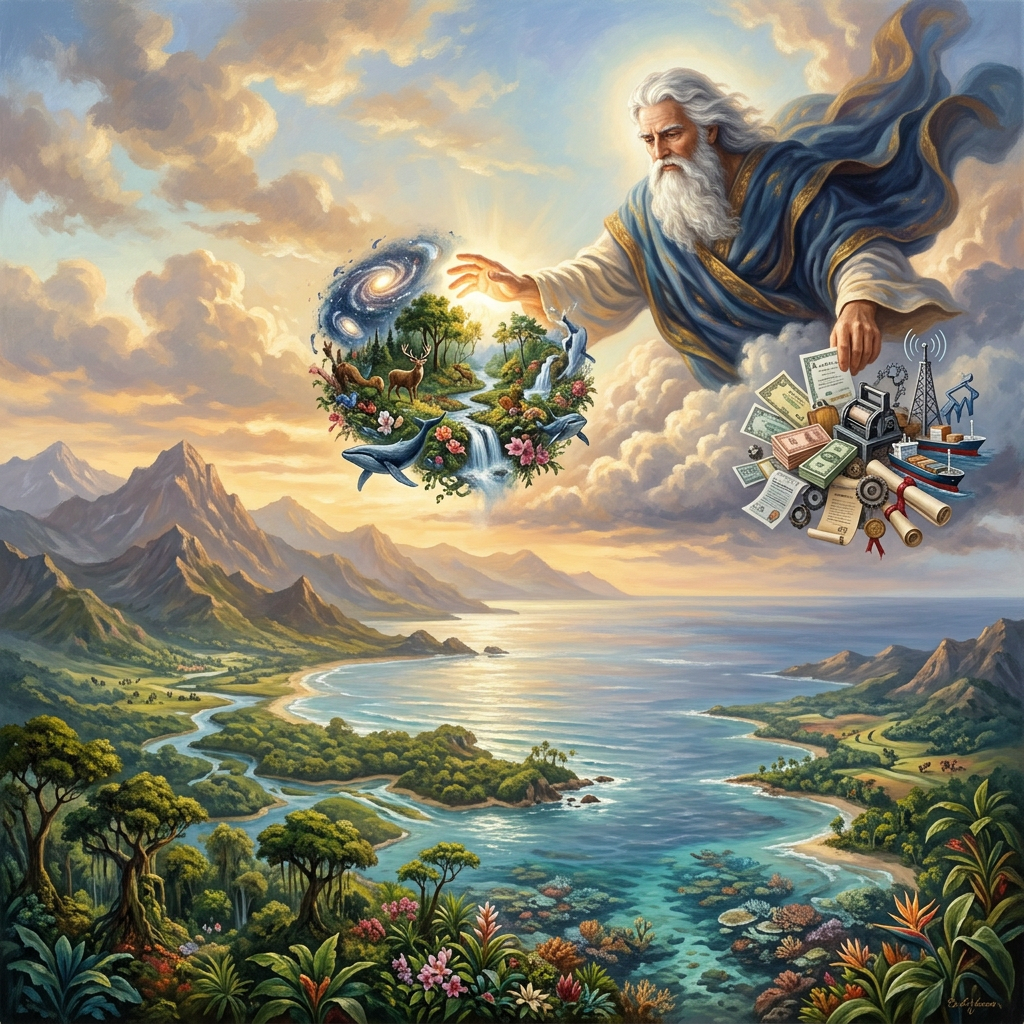
God vs. GOD
Who are you praying to? An Observational Piece
Here is a question nobody seems to be asking.
Why is IN GOD WE TRUST printed on every piece of United States currency?
Think about that for a second. Not as a cultural habit or a historical footnote. As a genuine question. Which God are we talking about? The God that created the oceans, the trees, the birds, the nervous system, the human body, the flower that grows through concrete without anyone’s permission — that God? The one that built a universe that runs on its own without filing any paperwork?
What would that God want with money?
This is not an attack on faith. It is an honest question about which God is actually being referenced when the word shows up on legal tender, in courtrooms, in the pledge of allegiance, and in the name of decisions made by people who were completely certain they had divine backing.
Two Different Things
There is the God of nature. The creator. The thing that made the dandelion, which grows without being planted, without being watered, without a single dollar changing hands, and which also happens to support liver function and kidney function and a dozen other things nobody mentions because there is no money in a weed.
That God does not appear to need a building. Does not require a government registration. Did not ask to be printed on currency. Built an operating system that runs continuously, at extraordinary complexity, without institutional support of any kind.
Then there is the God that shows up in institutions. The one that requires a 501c3 filing to be recognized by the government as legitimate. The one whose representatives align themselves with political movements and tell their congregations who to support in elections. The one whose name appears on money and in legal oaths and in the justifications for policies that have nothing obvious to do with creation, nature, or the kingdom of heaven being within you.
These are not obviously the same God.
That observation is not a conclusion. It is a question worth pondering.
Great Rhetoric or Honest Observation?
The legal fiction — every government document, every court filing, every piece of official paperwork — operates entirely in ALL CAPS. Your legal name on every government document. UNITED STATES. STATE OF ILLINOIS. All caps denotes the administrative construct. The fiction. The thing that references the living person or the living place without being the living person or the living place.
So does the God on the money.
IN GOD WE TRUST. All caps. The administrative version. The registered, recognized, institutionally approved version.
Call it great rhetoric if you want. Call it an honest observation about which God actually has real estate in the legal system if you prefer. Either way the question it raises is the same.
The creator God of nature has never filed paperwork. Has never needed to. The ocean isn’t IN OCEAN on a federal document. The nervous system doesn’t require institutional recognition to run. Nature just is. Lowercase. Present. No administrative construct required.
Which God is in all caps on the money is worth at least a moment of honest attention.
The Boardroom
Genesis 1:26 reads — “…let us make them in our image.”
Us. Our. Plural.
Most theological traditions have explanations for the plural voice. The trinity. The divine council. Angels present at creation. These are the approved interpretations delivered through the approved channels.
Here is a different observation. Not a conclusion. An observation.
The plural voice in a creation narrative sounds like a design meeting. A deliberate intention to produce something specific. Something that resembles the makers. Something built to a specification.
The creator God of nature does not appear to hold design meetings. The dandelion doesn’t have a committee behind it. The nervous system wasn’t workshopped. Nature produces without deliberation, without specification, without a stated intention to make something that looks like the people making it.
The boardroom language is in the text. What it means is a question each reader gets to think about honestly.
The God Who Needs You
The Bible describes a God who is jealous. Who demands worship. Who requires that you believe correctly and follow specific rules and acknowledge his authority or face consequences. That God has opinions about what you eat, who you sleep with, which other Gods you are not allowed to acknowledge, and whether you are sufficiently devoted.
Nature’s God has none of those requirements.
The ocean does not require your worship to keep moving. The nervous system does not demand correct belief before it heals. The sun does not withhold its rising from people with wrong theology. The creator’s operating system runs continuously and without condition for every living thing regardless of what that living thing believes about it.
A God who needs worship is a God who needs something from you. Whatever made the oceans does not appear to need anything at all.
That distinction is worth clarifying honestly before deciding which one is actually being referenced when the word appears on the money.
What Jesus Was Actually Pointing At
If you read Jesus carefully and honestly — not through the institution that packaged him, not through the portrait on the dining room wall, but through what he actually said — a consistent thread emerges.
The kingdom of heaven is within you. Your body is God’s temple. Consider the lilies of the field, how they grow without toiling or spinning, and yet are clothed more beautifully than anything Solomon produced. The birds of the air are fed without storing or hoarding.
He kept pointing at nature. At the body. At the living, breathing, growing world as the primary evidence of what God actually is and where God actually lives. Not in the building. Not in the institution. Not in the political arrangement. In the lily. In the bird. In the body that beats without being asked to. In the kingdom that was already within you before anyone told you it required an intermediary to access.
Whether you take him literally or allegorically the direction he kept pointing was the same. Inward. Natural. Already present. The creator God of nature. Not the one on the money.
They Chose the Fiction
The allegory in the story is worth reading honestly.
When the crowd was given a choice — release Jesus or release Barabbas, a known criminal — they chose Barabbas. They chose a man who had caused actual harm over a man teaching direct accountability and direct relationship with the source. Given the choice between truth and the comfortable arrangement they had built their lives around they chose the arrangement.
That choice is not ancient history. It runs in every era. People will consistently choose the fiction over uncomfortable truth not because they are evil but because the fiction offers something nature’s God does not. Someone to thank when things go well. Someone to petition when they don’t. Someone to blame when the results aren’t what was expected.
Nature’s God doesn’t offer any of that. Natural law runs on cause and effect without a complaints department. The body reports honestly on what it receives regardless of how sincerely you wanted different results. The ecosystem produces consequences without moral judgment. There is no one to petition and no one to blame.
Jesus was teaching accountability in a world that wanted intercession. He was pointing at the cause of disease in people who wanted the symptoms managed. He was saying the kingdom is already inside you to people who had built an entire social and economic structure around needing someone else to provide access to it.
They couldn’t afford for that to be true. So they chose Barabbas.
The pattern has been running ever since.
Original Sin and the Substitution
Consider the aboriginal person.
Living in direct relationship with nature. Breathing the same air, drinking the same water, born and dying within the same operating system that produced the oceans and the nervous system and the dandelion. No institutional layer between them and the source. No building to attend. No record to be entered into. No approved intermediary required to access what is already present in every breath.
Are they disconnected from the creator because they never read the Bible?
Are they living in original sin because nobody told them they were supposed to use the middleman?
The question is genuinely funny once you see it. By the framework’s own logic the person who never encountered the institutional layer is living in closer alignment with what Jesus kept pointing at than someone who accepted the substitution and is now working their way back through layers of mediation to find what was never missing in the first place.
They only know to connect with God. Nobody told them about GOD.
The creation narrative describes a state of direct relationship before the knowledge of good and evil arrives. The garden. Direct access. No intermediary. No judgment system required to navigate the relationship between the created thing and whatever created it.
Then the knowledge of good and evil arrives and everything changes.
The institutional GOD runs entirely on the knowledge of good and evil. It requires the judgment system to function. Without the assessment of sin there is no need for the intermediary. Without the intermediary there is no institution. Without the institution there is no building, no registration, no tithe, no political alignment, no name on the money.
What if original sin is not a moral failure but the acceptance of the substitution? The institutional GOD in place of the creator. The fiction in place of the living reality. The moment the operating system shifted from direct relationship with the source to managed relationship through the approved channel.
Not a fall from moral grace. An installation.
The aboriginal person who never encountered the substitution didn’t fall. They stayed. In the direct relationship. In the present moment that was always already the kingdom of heaven.
The 501c3 God
To open a church in the United States you need the government’s permission in the form of tax exempt status. The 501c3 designation.
In exchange for that designation the organization agrees to certain limitations on what it can do and say in the political arena. The arrangement is framed as a benefit to the church. It is also by definition a relationship between the church and the state in which the state has something to offer and something to withhold.
Which God do you think gets talked about in an organization that has entered into that arrangement?
The God of nature does not require institutional recognition. The flower does not need a 501c3 to grow. The nervous system does not file paperwork before healing. The creator’s operating system runs without the government’s approval or disapproval.
The institutional God needs the arrangement. Needs the building. Needs the registration. Needs the political relationship. Needs the money with the name on it.
Nobody in most churches is talking about the body as God’s temple. Nobody is talking about the kingdom of heaven being within you. Nobody is talking about the fact that the dandelion in your yard is free medicine that the creator put there without charging anyone for it.
They are talking about politics. About who is saved and who isn’t. About positions on things that have nothing obvious to do with getting closer to whatever made the oceans.
This is not everyone. The 80ish/20ish rule applies here as it applies everywhere. But it is enough people that it is worth naming.
The Missionaries and the System
The pattern is visible in history. Wherever colonial systems expanded the missionaries arrived first. Not after the economic and administrative structures. Before them.
The people living closest to nature — without legal systems, without institutional religion, without the administrative constructs that make taxation and governance possible — had to be introduced to the middleman before they could be introduced to the system the middleman served.
You cannot tax a people who have no relationship with the taxing structure. You cannot administer people who recognize no administrative authority. The God of nature requires neither. People living in direct relationship with nature, with the land, with the body, with the creator’s operating system as their primary reference point — those people do not need the institutional God and they do not need the systems that come with it.
That had to change before anything else could.
The missionaries were not bringing God to people who didn’t have God. They were bringing GOD to people who had God and didn’t know they were supposed to want the difference.
The missionaries came first. The administrative and economic systems followed. The sequence is documented history, not speculation.
IN GOD WE TRUST
The phrase appears on United States currency beginning in the mid 1800’s, and becoming mandatory on all currency in 1956 at the height of the Cold War when distinguishing America from godless communism was a political priority.
A political priority.
The God of nature did not ask to be on the money. The creator of the nervous system and the ocean and the bird that builds a nest without an architecture degree did not request placement on the federal reserve note.
Someone else put it there. For reasons that had everything to do with the institutional system and nothing obvious to do with the source of existence.
The question is not whether God exists. The question is which God is being referenced when the word shows up in legal documents, on currency, in political speeches, and in the justifications for things that the God of nature appears to have no opinion on whatsoever.
What Nature Actually Does
Nature does not have a PR department. It does not hold rallies. It does not ask for your vote or your tithe or your registration. It does not require that you believe in it correctly before it will let the sun rise.
It just runs continuously and contiguously. At a level of complexity that no institution has ever come close to replicating. Producing food, medicine, water, air, and the raw materials for every human creation that has ever existed — without billing anyone, without incorporating, without filing for tax exempt status.
Nature works best when you are aligned with truth. Not because it rewards alignment or punishes misalignment as a moral judgment. Because that is simply how cause and effect operates. Truth is the operating system. It’s just the design. Misalignment produces friction and eventually correction. Alignment produces function. That is not worship. That is physics applied to living.
The creator God and the institutional GOD produce very different results. The creator’s results are the oceans and the nervous system and the flower that grows through concrete. The institutional GOD’s results are on the money and in the news.
It is just worth noticing which God gets the building and which one gets the dandelion.
And asking honestly — when most people pray, which one are they actually talking to?
You Are Already In It
There is one more thing worth considering before the questions at the end.
You are never not receiving eternal life.
The present moment never ends. It just keeps being now. Which means the only eternity that is actually available to a living person is already here. Not after death. Not in the record. Not contingent on correct belief or sufficient devotion or getting your name in enough places. Just this moment. Which is always happening whether you notice it or not.
Jesus pointed at this directly. I AM is present tense for a reason. Not I was. Not I will be. The kingdom of heaven is within you — not will be, not was, is. The teaching kept landing in present tense because that is where the thing being pointed at actually lives.
The fiction’s eternal life requires death first. The institutional GOD’s promise of continuation is always deferred — after you die, after judgment, after the right conditions are met. The present moment’s eternal life requires nothing except being here. Which is the one thing that is always already happening.
The machine pulls you out of it constantly. Into the past file or the future scenario. Into the record of what happened or the projection of what might. The present moment is the one place the machine cannot follow for long because there is nothing there for it to work with. No file to pull. No scenario to run.
Just this. Just what is.
Which may be the simplest and most honest definition of the kingdom of heaven available. Not a destination. Not a reward. The moment you are always already in when you stop looking somewhere else for it.
Everything religion is selling you, you already have. The eternal life. The kingdom. The temple. The direct connection to the source. None of it was ever somewhere else. None of it required the intermediary. None of it was contingent on the correct membership or the approved belief or the name on the money.
It was here the whole time.
It is here right now.
The Thing That Wants to Be God
Here is where the framework runs out of certainty and becomes something more useful — a set of questions worth sitting with.
What does it mean to worship the thing that wants to be God rather than the thing that actually is God?
The institutional GOD resurrects. It takes what existed, packages it, and brings it back in a managed form. Jesus the teacher becomes Jesus the brand. The natural healing becomes the pharmaceutical. The free medicine in the yard becomes the patented compound. The direct relationship becomes the intermediary. Something real gets taken, processed, and returned as something the institution controls.
The creator God creates. From nothing. Without prior material. Without institutional approval. The dandelion. The nervous system. The consciousness reading these words. None of it required resurrection because none of it started as something else.
Which brings the question of eternal life into interesting territory.
What kind of eternal life does the institutional GOD actually offer? Your name in the record. The legal entity that outlives the body. The estate administered after the person dissolves. The corporation that continues. The legacy managed by the institution. The fiction preserving what nature would simply recycle.
Socrates. Shakespeare. Genghis Khan. Einstein. Buddha. Jesus. Bin Laden. Da Vinci. Every name that achieved institutional immortality did so through the record. Nature recycled their bodies on the same timeline it recycles everything else. What persisted was the administrative and cultural record. The name in the fiction. The legacy managed by institutions that outlived the person.
The fiction preserves all of them with equal mechanical indifference. It doesn’t require that you were good or true or aligned with nature’s God. It requires that you made enough of an impression on the record to stay in it.
That is a completely different standard than anything Jesus or Buddha were actually teaching.
Nature recycles. The fiction preserves records. The creator God makes new things. The institutional GOD keeps the old ones going in new containers.
These are not conclusions. They are questions for people willing to think past the bumper sticker.
What are you actually worshipping? What kind of immortality are you actually being offered? And who benefits most from you not asking either of those questions out loud?
Two Feet
This article is not an argument against the institutional side of the equation.
Institutions serve real functions. The legal system produces a degree of social order that matters. Community organized around shared values produces genuine care and genuine connection. The record preserves things worth preserving. These contributions are real and don’t disappear because you can also see their limitations clearly.
The problem has never been that the institutional side exists. The problem is the imbalance. One foot on the ground and one foot lifted. The natural side of the relationship — the direct connection to the source, the body as temple, the kingdom within, the present moment as the only eternity actually available — that side has been underattended for long enough that most people have forgotten it was ever there.
A person standing on one foot is anxious, reactive, and perpetually off balance. They need more from the system because they have nothing else to stand on. They are either endlessly entitled to what the fiction owes them or endlessly obligated to what they owe the fiction. Both dependencies produce the same result — a person whose entire sense of self and security is located in the institutional layer with no grounding in the natural one.
The fiction is not in a healthy state. Not because it is evil or illegitimate but because it is being asked to carry weight it was never designed to carry. People who have no relationship with the natural side of the equation bring all of their need, all of their meaning, all of their identity to the institutional layer and then wonder why it keeps failing to deliver what only the other foot can provide.
People who can stand on both feet put less pressure on the system not more. They need less from it. They see it more clearly. They can participate in it without being captured by it and step back from it without being destroyed by it. They take care of nature because they know they are nature. They engage with the institution because they understand what it is and what it isn’t.
That balance is not anti-institution. It is not anti-God in any form. It is the most stabilizing thing available to both the individual and the system they participate in.
The natural side of God has been underattended. The institutional side has been overloaded as a result.
Two feet. Both on the ground.
That is the whole observation and a whole observation.
Everything else follows from it.





Leave a Reply