
The Bullshit Machine: Hard Reset Skool Community is now LIVE and it’s FREE!
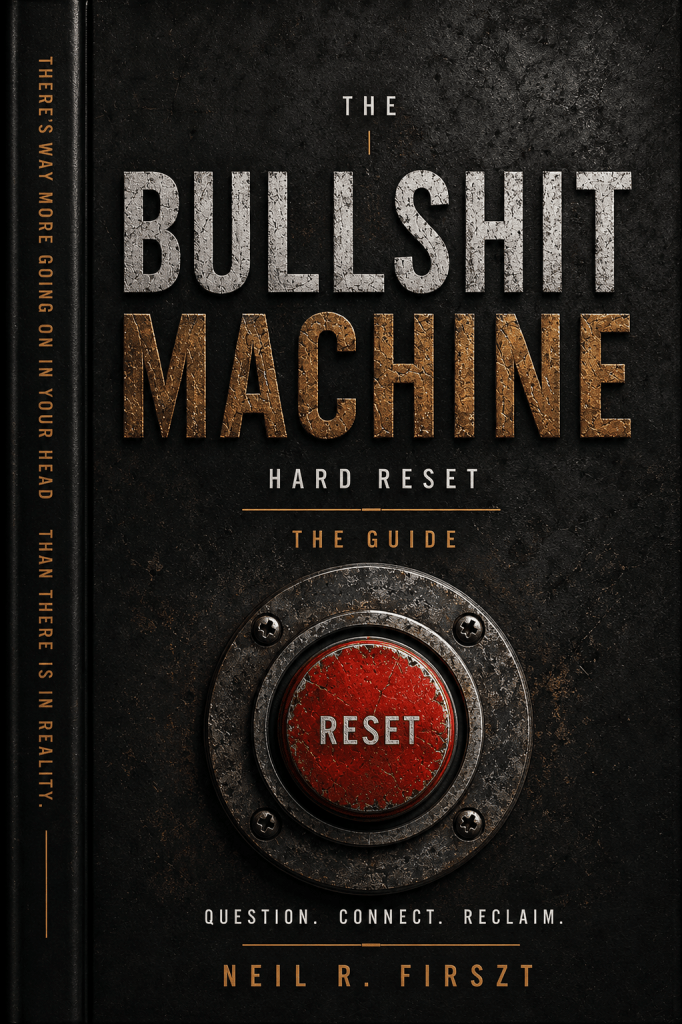
GET THE BOOK HERE!
The Bullshit Machine Supreme: The Full Arc is Available Now!
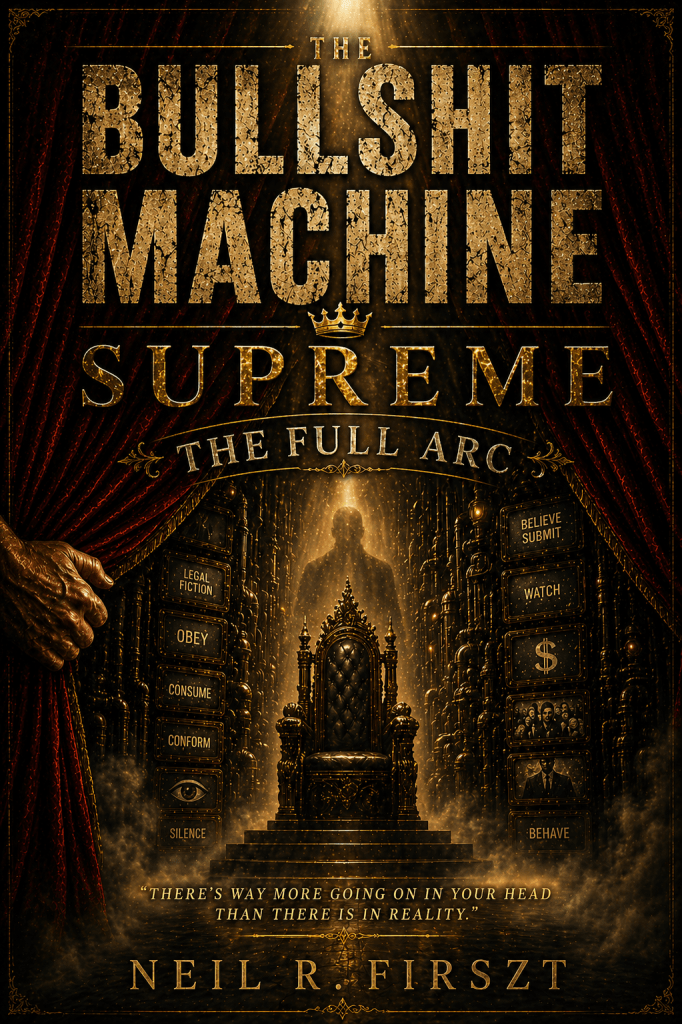
The Bullshit Machine Supreme: The Full Arc
Most people sense that something is running their life that isn’t quite them.
Not a vague dissatisfaction. Something more specific than that. The pattern that keeps producing the same results regardless of how sincerely they want different ones. The ceiling that feels like sky. The voice that sounds like theirs but says things they wouldn’t choose to say if they were actually choosing. The version of themselves that shows up in high-stakes moments and makes the same move the last version made, even though they swore this time would be different.
That’s not a character flaw. It’s a system. And systems can be understood.
What the Book Is
The Bullshit Machine Supreme is the complete edition of the BSM series — all three books unified into the single volume they were always meant to be. It maps the internal and external systems that have been running human behavior without consent or awareness, traces those systems to their origins in childhood, culture, and the body itself, and gives the reader the specific conditions under which those systems lose their grip.
It is organized in five parts.
Part One is personal. One man’s specific, honest, occasionally funny accounting of what the machine looks like from inside a life it ran completely — the addiction, the abuse, the patterns that kept producing the same wreckage regardless of how sincerely he wanted something different. This section earns the rest of the book the right to say what it says.
Part Two is architectural. The full map of how belief becomes load-bearing, how the external machine — manufactured consensus, legal fiction, imagery mechanics, the argument economy, institutional religion, artificial intelligence — produces the perfect operating environment for the internal one. The machine inside you and the machine outside you run on compatible software. They were built for each other. Part Two explains how and why.
Part Three goes into the body. Not as metaphor. As anatomy. The solar plexus, the diaphragm, the fascia, the sacral nervous system — these are the specific locations where the activation that never completed got stored and has been running as current ever since. Understanding why insight alone doesn’t change behavior, why you can know a pattern completely and still run it, why the work has to be physical rather than purely intellectual — that’s Part Three.
Part Four is practical. Eight fundamentals — not a program, not a sixty-day transformation with phases and a completion date — the specific operating conditions the body needs to stop running the machine’s signal and start running its own. These are not interventions. They are conditions. The difference matters and the book explains why.
Part Five goes underneath all of it. To what was there before the first belief arrived. To the foundation that no record, no institution, no story, and no machine can outrank. To the question of what you actually are when the programming is accounted for and set aside.
What It Is Not
It is not a self-help book in the conventional sense. It does not promise transformation in exchange for compliance with a system. It does not sell the bridge between who you are and who you’re supposed to be — it questions whether the gap was ever real.
It is not a conspiracy theory. The systems it describes do not require coordination or malice to operate. They require incentive structures, which are considerably harder to dismantle than a conspiracy and considerably more useful to understand.
It is not comfortable reading in all places. It goes to locations most books approach at an angle and retreat from before they arrive. It names things plainly that the culture has a significant investment in keeping unnamed.
What It Actually Does
It makes the machine visible.
Not as an enemy. Not as something to fight. As a system — specific, mappable, physical, historical — that was built before you had any say in the matter and has been running as your personality ever since. A system built by a child, from the only materials available, in the only way the circumstances allowed. A system that kept you alive and did its job.
A system that is no longer the right tool for where you are going.
The ruling class already knows how the human nervous system works. They have known for a long time. They know what manufactured urgency does to decision-making. They know that a population kept just destabilized enough manages itself. They know that the gap between who you are and who you’re supposed to be is the engine of every market they have ever built.
What they need — what the entire operation depends on — is you not knowing what you are.
This book is what knowing looks like.
The ceiling is not the sky. The version of you that is supposed to be visible has been behind the protection system the whole time. Not broken. Not missing. Not requiring reconstruction before it’s ready for the world.
Just protected.
By a machine that doesn’t know the conditions changed.
Welcome To The Bullshit Machine
Click here to listen for free!
What you’ll find here
My goals are to learn more about how the Bullshit Machine operates to try and understand how this experience of life works. This is a labor of love for our existence and our consciousness, and it’s my way of honoring my experience here. I will get many things wrong as I continue to work things out, and that’s okay. I believe we are usually just one or two pieces of information away from a deeper understanding about any situation, and that’s what I will explore. Let government agencies, the media, and NGO’s alike, pretend like they have answers while we explore the truth.
My book, “The Bullshit Machine,” is just the beginning for me. Understanding the internal patterns, behaviors, anxieties, addictions, and overall programming that come with the current zeitgeist is a big step to understanding what is happening in the external without victim consciousness. I used to want to “wake everyone up” and “save the world”, but those days are over. People build their own prisons, and if they don’t want to be free, then it’s not my job to show them that the gate is open. So now I just point things out and if you can see it, then great, and if not, then maybe you’ll see it one day soon. I’m not your hand holder.
I still work with people and their addictions and patterns and stuff sometimes, but only if they’re willing to put in the effort to change the patterns and behaviors they’re trying to change. If people don’t change what got them there in the first place, then everything will always revert back to the original bullshit machine. If you do want to work with me, I’d recommend listening to my book first, so you can get an idea of what I’m all about. That’s one reason it’s here for free. Then, send me an email so we can set up a conversation to determine whether or not to move forward.
Enjoy your time here in the Bullshit Machine.
What’s Inside the Books?
The core concepts of Neil Firszt’s 2020 book The Bullshit Machine: Transcending the Delusion of Who We Think We Are revolve around recognizing and dismantling an internal psychological and perceptual system that keeps people trapped in unconscious patterns, suffering, and limited self-identity. Firszt, drawing from his personal recovery from severe alcoholism, anxiety, depression, and self-hatred (including a period of heavy daily drinking), frames the “Bullshit Machine” as an autopilot mechanism—essentially the ego combined with lifelong conditioning—that generates thoughts, emotions, stories, and narratives we mistakenly identify as our true self.
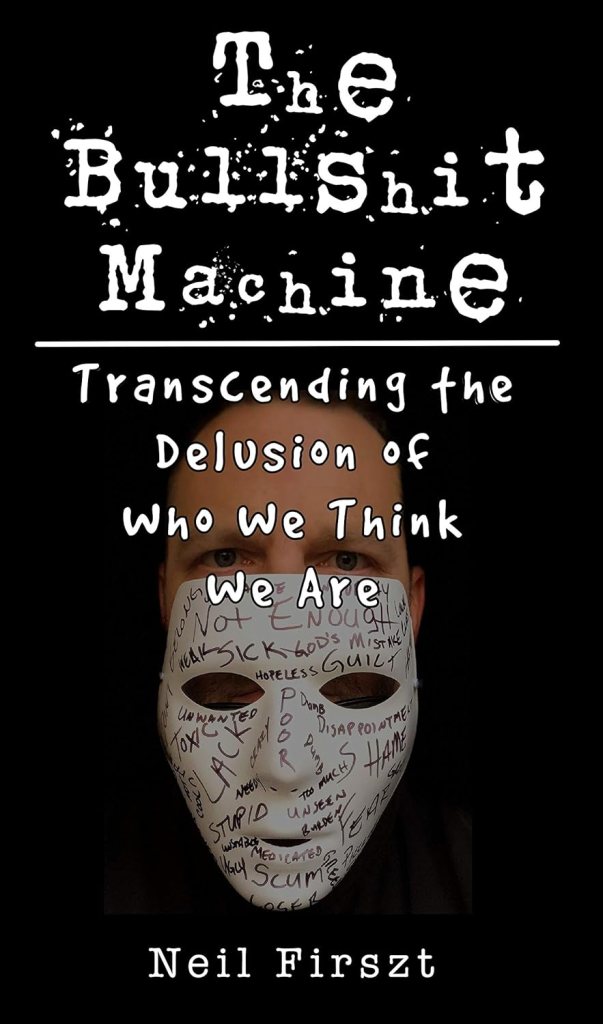
The Bullshit Machine Itself
- It operates like an internal program or “hamster wheel” of repetitive mental chatter, beliefs, and reactions that run without our conscious choice.
- This machine feeds us delusions: victim consciousness, feelings of inadequacy, anxiety loops, addictive cravings, and stories about who we “are” (e.g., “I’m broken,” “I’m not enough,” or “Life is unfair”).
- It thrives on misattribution—blaming external circumstances for internal states—while ignoring how our attention and focus sustain the cycle.
- Key insight: Much of what we experience as “me” (thoughts we didn’t choose, unwanted emotions, bodily sensations) is content generated by this system, not our essential awareness or being. The book asks questions like: “Who is thinking the thoughts I don’t want?” and “Do I even have a choice?” to highlight this disconnect.
Delusion of Identity
- We are not the anxious, addicted, limited, or entitled persona the machine convinces us we are.
- “Who we think we are” is a constructed narrative built from programming (childhood conditioning, societal expectations, past traumas, and habitual thinking).
- Transcending this involves realizing a deeper, constant awareness that predates and observes all the content (thoughts, beliefs, stories). This awareness is the “territory,” while the machine’s output is just a “map.”
- The book ties into broader themes of spirituality, psychology, and humanity: questioning “Who am I really?” beyond labels, roles, or suffering.
Awakening and Breaking Programming
- Many people reach a “rock bottom” or “moment in the mirror” where the machine’s lies become undeniable, sparking an awakening.
- Symptoms and triggers include chronic anxiety, addictions, out-of-control feelings, unwanted thoughts, and physical sensations that we try to medicate or suppress.
- The process isn’t about fixing the machine but seeing through it—shifting from unconscious identification to conscious observation.
- Tools emphasized: Self-inquiry (honest questioning of beliefs and patterns), awareness (watching thoughts without attachment), and redirecting attention/focus away from the machine’s narratives.
Practical Outcomes and Approach
- By dismantling identification with the Bullshit Machine, readers can reduce anxiety, overcome addictions, reclaim agency, and live more authentically.
- Firszt’s tone is raw, honest, and sometimes humorous or confrontational—he shares his own journey openly to model vulnerability and self-discovery.
- It’s not a step-by-step “how-to” with hand-holding; it challenges readers to do the inner work themselves, as no one else can “fix” your programming.
- The book explores related ideas like the power of presence, the illusion of control through external fixes, and reconnecting to a sense of source or higher awareness (without rigid dogma).
The Bullshit Machine 2: Navigating the Design of What We Are (released March 2026, Kindle-first) is the direct sequel to the 2020 original and the middle volume of Neil Firszt’s Bullshit Machine Trinity. Where Book 1 focused on recognizing the internal autopilot system (the “Bullshit Machine” or BSM) that generates thoughts, emotions, stories, addictions, and the false sense of self, Book 2 shifts into navigation—what to do once you’ve seen the machine clearly. It’s not about fixing, optimizing, or “improving” the machine. It’s about understanding the underlying design of human experience itself: what exists before the programming, how the machine was installed, why it runs, and how to operate from the territory instead of the map.
The tone remains raw, unflinching, and conversational—Firszt’s signature blend of car-salesman pragmatism, personal rock-bottom honesty, and zero hand-holding. He draws from two decades in the high-pressure car business (a “master class in the gap between what is true and what is being said”) and his own recovery journey, but the book is framed as a dare rather than a manual. It asks: If you’ve already woken up to the patterns running your life, why do you keep letting them? And what happens when you stop feeding the operating system that was never yours to begin with?
Core Concept: The Design Behind the Machine. The central premise is that the BSM is not the enemy—it’s an extraordinarily sophisticated piece of engineering built from childhood conditioning, cultural programming, defense mechanisms, and real-time updates. It was constructed for you, not by you, and it runs as the default operating system beneath your conscious awareness. Most “decisions” aren’t decisions at all; they’re outputs of this program, and you’ve been mistaking the readout for “you.”
Book 2 goes deeper than simple recognition: it examines the design of what we are—the pre-programmed essence, the biological and existential continuity that predates every story, belief, or identity the machine overlays. The machine thrives on substitution (maps for territory, records for being, symptoms for root causes). Navigation means seeing through those substitutions and returning to the signal underneath. Key Themes and Structure. The book splits roughly into two halves:
- Understanding the Machine’s Architecture
- The Origin Problem (a standout early chapter): The one question the system cannot answer without exposing itself. “When did you come into being?” The BSM (and the administrative/legal systems it mirrors) claims existence begins with a record—birth certificate, social security number, etc. But biology and simple logic show continuity from the zygote onward: the zygote is the “immediate father” (in the original sense of “one who gives rise to something else”), and the adult human is simply the unfolded expression of that singular origin. No separation. The system inverts this: record precedes being, symbol substitutes for source. This inversion is the foundational “tell” of the Bullshit Machine—personal or collective. It creates legal fictions, claims sovereignty over identity, and relies on participation-as-consent arguments that collapse under origin logic. The chapter dismantles how the machine (and institutions) quietly assert “you exist because we noticed you,” while avoiding direct confrontation because truth makes its tools irrelevant. bullshitmachine.net
- Architecture of Belief: How beliefs start as useful tools but quickly become the prison. The exact moment a belief stops serving you and starts running you. The book maps how the machine produces persuasive reasons for every pattern, calibrated perfectly to your history.
- Four Irreducible Truths (or unarguable truths): Simple, non-negotiable facts about awareness, origin, continuity, and reality that no authority, system, or argument can touch. These act as anchors that starve the machine’s need for complexity and narrative.
- Practical Navigation – The Eight Fundamentals
These are not tips, hacks, or phased programs. They are timeless conditions that remove the fuel the BSM depends on. Examples explicitly named include clean water, quality salt, movement, fasting, gratitude, silence, breath—and a few more that “change the signal” rather than add more inputs for the machine to manage. They work on the body and the underlying awareness because they operate at the level of the design itself. The machine hates simplicity: it prefers elaborate 60-day protocols with apps and excuses. These fundamentals are boring on purpose—they give the machine nothing to optimize or abandon. bullshitmachine.net- Presence: The only state where the Bullshit Machine has zero traction. Not a practice to achieve, but the default when identification with the machine’s content drops.
- Legal Fiction, Personal Sovereignty, and the Correct Order of Things: Extending the Origin Problem outward, the book clarifies that identity is conserved from origin—it is not assignable. Government/administration is posterior to the human being, legitimate only for resolving harm, never for defining being or rights. Sitting still long enough to discover who you actually are is framed as “the most dangerous thing you can do” because it threatens the entire overlaid system (internal and external).
What This Book Is (and Isn’t)
- Not self-improvement. Self-improvement assumes the self (the machine’s construct) needs fixing. This is recognition—returning to something you never left. The quiet, slightly disappointing, enormously liberating discovery that what you were looking for was never missing; the machine was just loud enough to drown it out. You are not the story the machine tells. You are what the machine was built on. bullshitmachine.net
- Not polite. It calls out engineered dependency, distraction, and monetizable states without soft language.
- Not for everyone. It’s for the person who has reached the “mirror moment” where continuing to call the machine’s outputs “my choices” feels embarrassing.
Firszt shares full chapters and readings on bullshitmachine.net (with Kindle promo periods) and his X account. This volume feels like the bridge that turns awakening from a one-time insight into sustainable navigation. It’s simple by design—because simplicity is what finally starves the Bullshit Machine. Available on Amazon Kindle now with supporting material and direct support options via the site.

The Bullshit Machine 3.33: The Truth Shall Set You Free
There is a version of personal development that stops at the mind.
It gives you frameworks. Better thoughts. New beliefs to replace the old ones. A more useful narrative about who you are and what happened to you and where you’re going. And then it sends you back into your life and watches, from a comfortable distance, as the framework holds for three weeks and then quietly dissolves because the thing it was supposed to address never lived in the mind in the first place.
The Bullshit Machine 3.33 is where the work goes deeper than that.
Not as philosophy. Not as a better framework to replace the last one. As a direct confrontation with the physical, physiological, and cultural machinery that has been running human behavior at levels most personal development never reaches and most people never examine. This is the book that goes to the places the first two books were pointing toward but hadn’t yet fully arrived at. The body. The nervous system. The sacral plexus. The fascial tissue that stores what the mind cannot process. The external systems — institutional, legal, technological — that have been doing compatible work from the outside your entire life.
And underneath all of it. The truth that was there before the first story began.
What This Book Does
The Bullshit Machine 3.33 operates on three levels simultaneously.
The first is physiological. Most people understand intellectually that trauma lives in the body. Very few books go to the specific anatomical address. This one does. The solar plexus as the largest nerve complex outside the brain. The diaphragm and its direct relationship to the threat response. The fascial system that remodels itself around chronic emotional states and holds the physical memory of experiences that never completed. The sacral nervous system and the specific mechanism by which childhood activation without completion installs patterns that the adult nervous system has been trying to resolve ever since through whatever channel is available. This is not abstract. This is anatomy. And the anatomy has implications for why insight alone doesn’t change behavior and what kind of work actually does.
The second level is cultural. The Bullshit Machine has an external version that has been doing compatible work from the outside. The manufactured consensus that installs working models of reality in the minds of people who never examined the installation. The legal fiction that mistakes the administrative record for the living person it was supposed to represent. The imagery mechanics that move the window of what a population believes is possible without anyone noticing the window moved. The argument economy that profits from keeping truth permanently just out of reach. The artificial intelligence that has inherited the entire operation and is running it faster and more thoroughly than any human institution ever could. These are not separate problems. They are the same machine running inside and outside simultaneously on compatible software.
The third level is foundational. Underneath the physiological and the cultural — underneath all of the programming, all of the strategies, all of the compliance training and manufactured consensus and stored activation — there is something that was there before any of it arrived. Something the record did not create and the institution cannot administer and the machine cannot reach. The I AM state. The awareness that preceded the first belief. The ground that the story appears in but cannot contain. The Bullshit Machine 3.33 goes there. Not as theology. As a precise description of what has been there the whole time.
The Truth That Sets You Free
The title is not a promise. It is a mechanics description.
The truth — not conviction, not consensus, not the manufactured version delivered through approved channels — is self-maintaining. It requires no defense. It needs no institution to protect it. It does not expire when the consensus shifts or lose its validity when the argument goes against it. It simply remains. Steady. Available. Unchanged by the amount of noise generated in its direction.
The machine, by contrast, requires constant maintenance. The beliefs it runs have to be continuously reinforced. The identity it produces has to be continuously defended. The ceiling it maintains has to be continuously mistaken for the sky. The moment the examination starts — the moment the honest question gets asked and held long enough to receive an honest answer — the maintenance cost exceeds what the fiction can generate to sustain itself.
And the fiction collapses.
Not dramatically. Not all at once. The way a lie collapses when the person telling it finally gets tired of remembering which version they told to whom. Quietly. With relief on the other side that nobody expected.
That collapse is what the title means. The truth doesn’t liberate you by giving you something new. It liberates you by removing what was never real. The gap that required the bridge. The insufficiency that required the institution. The ceiling that required the managed altitude. The story that required the protection system.
Remove the fiction and what remains is what was always there.
That’s the liberation. Not a new identity. Not a better story. The recognition of what was there before the first story began.
Who This Book Is For
It is for the person who has done the work — therapy, meditation, self-examination, genuine effort over real time — and still finds the pattern running. Who knows exactly where it came from, can describe the mechanism in precise detail, and still flinches when someone raises their voice. Who understands that the ceiling is not the sky but cannot seem to get above it. Who has accumulated insight without the insight accumulating into change.
That person is not failing. That person is working at the wrong address.
The address is the body. The nervous system. The specific physical locations where the programming lives and where the correction has to happen if it’s going to happen at all.
This book gives you the address.
It also gives you something rarer. The honest account of someone who went there. Not as a guide standing safely above the material pointing down at it. As someone who had to go there because there was nowhere else left to go. Who found what was on the other side of the programming not through heroism or discipline or finally finding the right framework but through the simple exhaustion of everything else.
The truth is not complicated.
It never was.
It was just buried under a very sophisticated machine that had a very strong interest in staying buried.
That machine has a name.
You already know what it is.
And now you’re going to find out what’s underneath it.
The Book of Bullshit Machine: Solid Perspectives & Questioning Narratives in Biblical Fashion (2026), a novelty addition to what Neil Firszt calls The Bullshit Machine Trinity. It builds directly on the foundational ideas from the original 2020 book (The Bullshit Machine: Transcending the Delusion of Who We Think We Are) and its sequel (The Bullshit Machine 2: Navigating the Design of What We Are), but shifts into a distinctive stylistic and applicative mode. Core Concept and Style.
This book takes the internal “Bullshit Machine” framework— that autopilot ego/programming system of repetitive thoughts, narratives, addictions, victim stories, and identity delusions—and applies it outward to societal, cultural, and collective programming. It does so using biblical-style prose: short, rhythmic, parable-like chapters (e.g., “The Book of COVID,” “The Book of Moon Landing,” “The Book of Caesar,” “The Book of Smith-Mundt”) that question dominant narratives without preaching or hand-holding.The biblical format isn’t mockery or satire for its own sake. Firszt describes it as “technology”—an ancient delivery system designed to bypass modern mental defenses and the reader’s own Bullshit Machine. The cadence lowers resistance, humor slips past filters, and the content lands before the internal programming can fully reject it. It’s confrontational yet accessible, blending raw insight with dry wit to expose how the same machine running inside individuals also scales up to shape consensus reality, compliance, media, institutions, and belief systems.
Key Themes and Expansions on Core Concepts
- The Machine’s Architecture in the Collective: It revisits the personal “hamster wheel” of thoughts and stories from the first book, but shows how it aggregates into larger systems—propaganda loops, legal fictions, fear-based compliance, grifting prophets (e.g., televangelists with private jets), and closed-loop addictions like pornography or outrage cycles. The machine doesn’t care about truth; it cares about perpetuating itself through belief, attention, and repetition.
- Questioning Narratives Without Victimhood: Chapters dissect specific “sacred cows” or historical/cultural stories (COVID responses, space programs, power structures) not to push conspiracy but to model honest self-inquiry applied externally. The goal is seeing through delusion—personal or shared—without falling into new victim narratives or savior complexes. Firszt emphasizes: people build their own prisons; the gate is open, but most prefer the familiar cage.
- Awakening and the Mirror Moment: Echoing the original book’s rock-bottom realizations, this one highlights collective “mirror moments” where the programming becomes visible. It includes reflections on belief stages (from useful tool to sealed-shut prison) and the difference between awareness (the constant observer) and the content the machine generates.
- Eight Fundamentals / Conditions: The book outlines timeless conditions of human experience that predate any programming—simple truths about awareness, attention, and reality that starve the machine when recognized. Simplicity is weaponized here: complexity feeds the Bullshit Machine; direct seeing dissolves it.
- Not Self-Help: Like the series as a whole, this isn’t about fixing or improving the machine. It’s about seeing it clearly so identification weakens. The machine “does not want you to finish” the book because completion risks disengagement from its loops.
Firszt often shares excerpts and readings on his X account (@bullsh1tmachine) and site (bullshitmachine.net), including free Kindle promo days and blog posts with full chapters. The tone remains consistent: no hand-holding, high emphasis on personal responsibility, and a reminder that the real “territory” is awareness itself, not the map of stories the machine draws. This addition rounds out the series as a powerful toolkit for dismantling both inner and outer illusions. If you’ve read the others, The Book of Bullshit Machine feels like the sharp, rhythmic punch that makes the earlier concepts land in new contexts. Available on Amazon, with supporting material on the site. –Descriptions provided by Grok



 The Bullshit Machine
Leave a comment