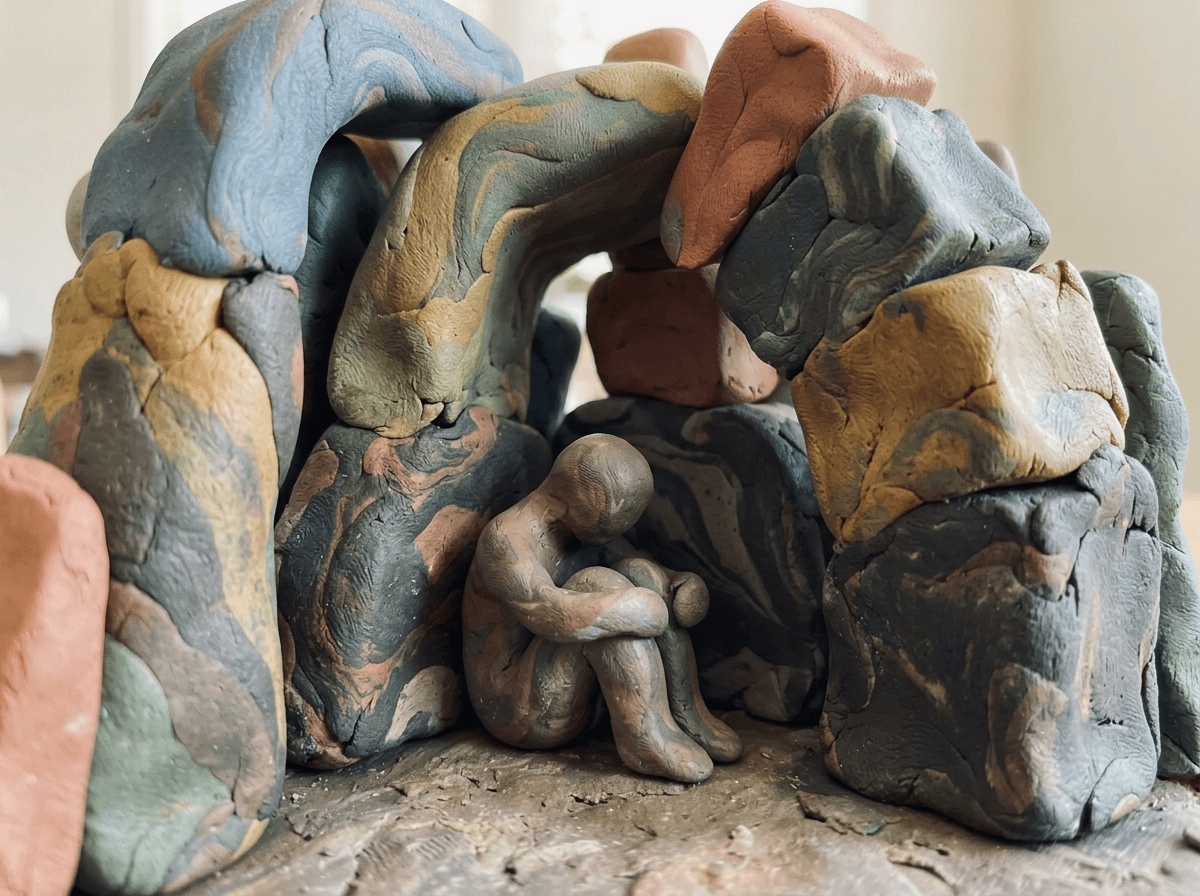
This is Chapter 30 from my new book “The Bullshit Machine Supreme: The Full Arc. Available 05/08/26 on Amazon
Stand up for a second.
Actually stand up. Put the book down, stand up, and notice what’s happening in your body right now. Where are your shoulders? Are they somewhere near your ears? What is your lower back doing? How is the neck? Are you holding your breath slightly and didn’t know it until just now?
Okay. Sit back down.
What you just noticed in those five seconds is the accumulated physical story of your life. Every chair you sat in too long. Every screen you hunched toward. Every pair of shoes that told your foot what shape to be. Every stress response that never fully discharged. Every time the body braced for something and then just stayed braced because the modern world never really gave it the all-clear signal.
That story lives in the structure. Not in the mind. Not in the story you tell about yourself. In the fascia, the joints, the nervous system, the way your weight sits on the ground and the way your spine stacks on top of that. The machine has been running in your head this whole book. But it has a physical address in the body too. Part Three gave you the physiology. This chapter gives you what to do about it.
We are talking about body decompression. The process of undoing what modern life has done to the human structure and restoring the movement patterns the body was designed to use. Not as a fitness program. Not as a performance protocol. As a condition — the physical operating environment that allows everything else in the fundamentals to land in the body rather than just in the head.
What Modern Life Does to the Structure
The human body was not designed for the amount of chair sitting we do.
I know that is not a revelation. Most people acknowledge it the way they acknowledge that processed food is bad for them — intellectually, from a distance, while continuing to sit in chairs for ten hours a day. So let’s get specific about what is actually happening.
The chair shortens the hip flexors. The screen pulls the head forward, which adds effective weight to the cervical spine with every inch it travels — a head sitting one inch forward of its natural position puts roughly ten extra pounds of load on the neck. Most people’s heads are sitting significantly more than one inch forward. Look around any public space and you will see it everywhere once you know what you are looking at. A population of people whose heads have migrated forward on their spines, whose chests have narrowed, whose hips have shortened, whose feet have been reshaped by footwear, whose contact with the ground has been mediated by cushioning systems so sophisticated the foot forgot it had a job to do.
The arch collapses. The ankle collapses. The knee compensates. The hip compensates. The spine compensates. The shoulder compensates. By the time you get to the neck and jaw they are carrying load that was never theirs to carry. And through all of this compensation the nervous system is running a quiet background program called protection — identifying certain positions and movements as risky based on the pain and restriction it has experienced and subtly steering you away from them.
You are not aware of this. You just notice that certain movements feel weird, or that you have a bad side, or that some things hurt for no obvious reason. The nervous system is not being dramatic. It is doing its job. It just needs to be updated on what is actually safe now.
Trauma lives here too. Not just physical injury — emotional and psychological stress stores itself physically. The fascia holds tension patterns from experiences that never got fully processed and released. This is not mystical. It is increasingly well-documented biology. Your anxiety has a posture. Your grief has a posture. The ten-year-old version of you trying not to take up too much space in a room that wasn’t safe has a posture. And that posture has been running underneath everything else this whole time.
You met this in Chapter 20. The anterior chest fascia carrying the preemptive self-destruction strategy. The posterior ribcage carrying the sympathetic threshold. The diaphragm braced against the completion that was never allowed to happen. You now know exactly what is stored in the structure and why. This chapter is what you do about it.
The Body Already Knows How to Move
Here is something that should make you feel both impressed by the design and slightly embarrassed about modern fitness culture.
The body already knows how to move. It came with the instructions. The movement patterns that preserve joints, generate power, absorb force, and allow a human being to cover ground efficiently for decades without breaking down — those are in the DNA. Every traditional culture that did not have chairs, modern shoes, or sedentary screen-based, work produced people who moved with a naturalness and efficiency that most modern humans have completely lost and are spending significant money trying to get back.
GOATA — Greatest Of All Time Actions — is a system built around studying how the best human movers in history actually moved. Elite athletes, traditional cultures, people who maintained full function into old age. What comes out of that study is a movement framework that is spiral-based and spring-loaded rather than linear and braced. The body in its natural state moves like a loaded spring. It stores energy on the way down and releases it on the way up. The joints are preserved because the load is distributed through the whole system instead of concentrated at single points.
Most people in the modern world have lost the spring. They are stiff and linear and braced, burning enormous amounts of energy just to move around, leaking it at every joint instead of generating and transferring it the way the system was designed to. They are also accumulating damage at the joints that bear the brunt of poor mechanics — the chronic knee pain, the bad hip, the recurring back issue that physical therapy helps temporarily and never fully resolves, because the movement pattern producing the problem never changed.
Your DNA has a movement manual. Modern life filed it somewhere and forgot about it. GOATA is one way to find it again. I am not affiliated with GOATA in any commercial sense. I am recommending it because it worked for me in a way that other approaches to movement did not, and because it goes after the mechanics rather than just adding load to broken mechanics, which is what most conventional fitness does.
Relearning these patterns is not complicated. It is significantly more interesting than a gym program because it is not about adding weight to a broken system. It is about restoring the system first so that every movement you do — walking, sitting, standing, playing, working — becomes part of the solution rather than part of the problem.
The Spine, the Nerves, and Why You Feel Like That
When the spine is compressed — and most people are walking around with compressed spines from years of the postures described above — the spaces between the vertebrae narrow. Those spaces are where nerves exit the spine and travel to every part of the body. Compress the space, compress the nerve. Compress the nerve and the signal it is carrying gets degraded.
This shows up as tingling, numbness, weakness, reduced sensation, or just the general low-level physical dullness that people normalize as aging or stress, when it is actually mechanics.
Blood flow gets restricted too. The vessels that run alongside and through the spinal structures get squeezed by the same compression. Less blood flow means less oxygen, less nutrient delivery, less cellular cleanup. The tissues around a compressed area become chronically undernourished and the nervous system reads this as threat and tightens further around it. The tightening increases the compression. The compression worsens the blood flow. The cycle continues until something intervenes.
Decompression breaks the cycle. When you create space in the spine and joints through the right movements and positions, nerves get room to breathe, blood flow improves, oxygen arrives where it has not been arriving, and the nervous system gets the signal that things are safe enough to release some of the protective tension it has been holding.
This can feel dramatic when it first happens. People describe the sensation of a tight area finally letting go as a combination of relief and a kind of aliveness that they did not realize had been absent. The body has been waiting for permission to release. Decompression gives it that permission.
You will recognize what happens next from Chapter 20. The vagus nerve has more room to operate. The anterior chest fascia gets space to breathe. The diaphragm can finally reach the bottom of its range. The voice drops back into the torso where it belongs. The solar plexus stops bracing against a compression that has finally been addressed. The whole system that Chapter 20 diagnosed starts to have the physical space it needs to actually function the way it was designed to.
Understanding the physiology in Part Three was the diagnosis. This chapter is the beginning of the correction.
The Ground Is Not Your Enemy
One of the stranger things that modern footwear has done is teach an entire population that the ground is something to be protected against.
The modern athletic shoe is an engineering marvel of cushioning, arch support, motion control, and stability features, all designed to manage the contact between your foot and the ground so your foot does not have to. The problem is that your foot was built to manage that contact itself. It has twenty-six bones, thirty-three joints, and over a hundred muscles, tendons, and ligaments specifically for that purpose. It is extraordinarily well-designed for the job. The shoe does the job instead, the foot gets lazy, the arch collapses, the intrinsic muscles atrophy, and then you need more shoe to compensate for the weakness that the shoe created.
Your foot is your contact point with the earth. How it sits, how it loads, how it pushes off — all of it travels up through the ankle, knee, hip, spine, and shoulder. Get the foot wrong and everything above it has to compensate. Get the foot right and you restore the foundation that the whole structure is built on.
This does not mean throw away your shoes immediately and run barefoot on concrete. It means start paying attention to what your feet are doing. Start having a conversation between your nervous system and the ground that shoes have been intercepting. Walk barefoot on grass or sand or any natural surface when you can. Even twenty minutes restores something the nervous system has been missing — the real-time feedback from the ground that is supposed to be informing every movement you make.
When that stability returns something interesting happens. I started feeling more grounded — and I mean that literally, not as a metaphor. More rooted. More present. More foundational. More physically connected to the reality of being in a body on the earth. The philosophical grounding that Part Five is going to discuss has a physical version that has to come first. You cannot be genuinely present in a body that has lost its connection to the ground it is standing on.
What Happens When the Body Opens Up
Pain goes down. Not all at once and not without some interesting sensations along the way as the tissues adjust to new positions and the nervous system updates its threat map. But consistently over time the chronic pain that people have accepted as permanent starts to shift as the mechanics that were producing it change.
Energy comes up. This one surprises people. Moving well is not just less damaging than moving poorly — it is actually generative. When the body is functioning with its natural spring-loaded mechanics movement produces energy rather than consuming it. You stop arriving places feeling like you walked through mud. The simple act of being in your body becomes less effortful and more enjoyable. People who have spent years dreading movement because it always hurt and always felt like a fight, discover that movement can feel good when the body doing the moving is properly organized.
The breath opens. Tight hips pull on the lower back which changes the position of the ribcage which restricts the diaphragm. A forward head compresses the throat and changes the mechanics of the breath. A hunched spine literally squeezes the lungs. When you decompress the structure, the breath has room to move the way it is supposed to move — full, three-dimensional, effortless.
And when the breath opens the voice opens. The voice that was sitting in the throat in Chapter 20 finds its way back into the torso where it belongs. The sentences start finishing themselves again. The material that was inaccessible on the podcast becomes accessible because the hardware it runs on has been given the physical space to function.
The fundamentals are not separate interventions. They are one connected system. The water gives the tissue what it needs to move. The meditation gives the nervous system the quiet it needs to update. The decompression gives the body the space it needs to breathe. The breath gives the voice its grounding. The voice gives the inner life its expression. All of it pointing in the same direction.
Where to Start
Get on the floor.
That is the instruction. I know it sounds too simple. The machine is already generating reasons why your knees are too bad for that, and you are too old, and you might not be able to get back up, and there is probably a more structured approach you should research first.
Get on the floor anyway.
Most adults in the modern world have not spent meaningful time on the floor since childhood. Which is its own commentary on how far we have drifted from natural movement. Look up how to do a seiza sit. Look up GOATA child rockers. Start there. Sitting on the floor, moving around on the floor, getting up from the floor and down to it regularly — these things alone begin to restore movement patterns that chairs and furniture have been bypassing for decades.
Walk barefoot when you can. Any surface that gives your foot actual feedback. Start the conversation between your nervous system and the ground. Even twenty minutes is enough to remind the foot that it has a job to do.
Look up GOATA. The material is available. The results are real. The people who built it spent years studying human movement at a level that most fitness approaches never go near, and they have people you can reach out to if you want to take it further. It is worth your time and it will change the way you understand what movement actually is.
Your body has been waiting a long time for this conversation.
It is patient.
But it would appreciate you starting soon.




 The Bullshit Machine
Leave a comment