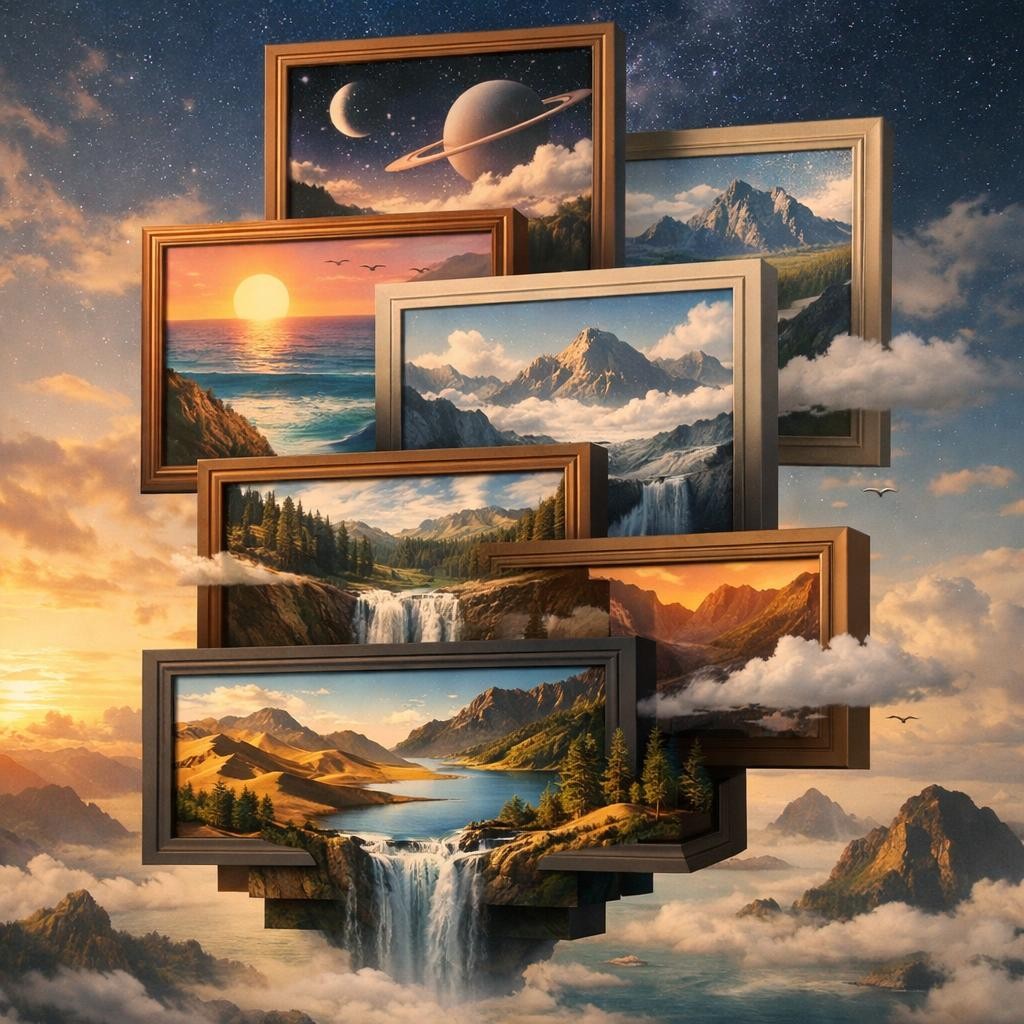
On borrowed imagination, installed reality, and the oldest mechanic in the world running on your newest device.
What You Actually See
Look at the moon tonight. Not a picture of the moon. Not a diagram. The actual moon, with your actual eyes, from wherever you’re actually standing. Take a moment with it before reading further.
What you saw was light. Shape. Context. A thing in the sky that your eyes delivered to your brain as raw unnarrated experience. No caption. No scale. No explanation of what’s happening on the surface or how far away it is or what the far side looks like or how it appears from orbit. Just the thing itself, as much of it as your position and your instruments — which is to say your eyes — could access.
Now close your eyes and picture the moon.
What you see is almost certainly not what your eyes just gave you. What you see is the image. The composite. The photograph from the textbook or the documentary or the NASA release or the phone screen. The finished, authoritative, fully-captioned version that someone else produced and delivered to you through a rectangle at some point in your life. That image moved in and the raw experience moved over. And the replacement happened so quietly you probably never noticed it was a replacement at all.
That is the mechanic. And everything else in this article is just the mechanic applied at scale.
The Replacement Nobody Feels
Here is what makes this worth examining carefully. The replacement doesn’t feel like a replacement. It feels like understanding.
When the installed image is vivid enough, complete enough, delivered with enough authority — the brain files it as knowledge. Not as something you were shown. As something you know. And from that point forward, when you encounter the real thing, your eyes don’t build a picture from scratch. They match what they’re seeing to the image you already have. Your direct experience becomes evidence for someone else’s picture rather than a source of your own understanding.
You look at the moon and confirm the image. You look at a crowd and confirm the narrative. You look at an economy and confirm the graph. You look at a war and confirm the footage. The raw experience never gets to speak for itself because the image gets there first, every time, and the brain — which cannot distinguish between a vivid image and an actual experience at the level where reality models get built — accepts the image as the ground truth.
“Your eyes become evidence for someone else’s picture rather than a source of your own understanding.”
This is not a flaw in human cognition. It’s a feature. The brain cannot directly experience most of what it needs to navigate. It builds models from available information. Images are information. The problem isn’t that the brain accepts images. The problem is that it accepts them without flagging the difference between what was directly experienced and what was installed by someone else’s apparatus.
And nobody told you to flag that difference. Because the people handing you the images had no interest in you flagging it.
The Oldest Rectangle
This is not a modern problem. The phone didn’t invent this mechanic. The phone just made it faster, cheaper, and total.
The first cave painting was someone telling you what the hunt looked like. The first temple fresco was someone showing you what God looked like. The stained glass window was the screen of its era — a vivid, backlit, authoritative image delivered to people who couldn’t read the text and would never visit the places depicted, installing a complete picture of reality in the mind of everyone who walked through the door. You couldn’t verify the image. You had no instruments. You had the window, and the window was magnificent, and the window told you everything you needed to know about heaven and hell and the nature of things, and after enough time in that building you could close your eyes and see it all clearly.
That clarity was not knowledge. It was installed imagery that felt like knowledge from the inside. And it governed behavior, shaped worldview, determined what was possible and what wasn’t, for centuries. Not because it was true. Because it was vivid and authoritative and there was nothing competing with it at the same resolution.
“The stained glass window was the screen of its era. You couldn’t verify the image. You had no instruments. You had the window.”
The phone is the window. The documentary is the fresco. The textbook illustration is the painting. The mechanism is identical across every era. What changes is the resolution and the delivery speed. The brain’s response to vivid authoritative imagery doesn’t change at all. It never has.
Understanding this is not an accusation. Nobody is the villain here. The mechanic exists. It has always existed. It gets used because it works. Water flows downhill. Imagery colonizes imagination. These are descriptions of how things work, not moral verdicts about anyone using them.
The Unfalsifiable Image
Some imagery is verifiable. You can test whether coffee is hot. You can confirm whether the road is wet. You can walk outside and check whether it’s raining. In the territory where direct experience is available, the installed image competes with something real and the real thing can win.
The dangerous territory is where direct experience is not available. Where you cannot get close enough to check. Where you have no instruments. Where the image is the only access you will ever have to the thing being depicted. In that territory the image doesn’t supplement reality. It becomes reality. It sets the boundary of what you believe is possible. And once it sets that boundary, it governs everything inside it without ever being questioned because it never has to compete with anything.
In 2022 the FArtemis mission released footage of the moon passing by the Earth from deep space. It is a stunning image. Vivid. Authoritative. Photographic. And essentially no one reading this was there. No one reading this has the instruments to confirm it. No one reading this can replicate the angle or verify the source independently. The image exists. NASA produced it. It is now installed in millions of minds as a clear picture of what that looks like — the Earth from that distance, the moon from that angle, the scale of things out there.
This is not a claim about whether the mission happened. That’s a different conversation and not the point of this article. The point is the mechanic. Whatever happened or didn’t happen, the image was produced by the only people claiming to have been there, delivered through a rectangle, installed in your mind as direct knowledge of something you cannot access, cannot verify, and will never be able to check. And it now lives in your imagination as the ground truth of what that looks like. If someone asks you to picture the moon from deep space, you will see that image. Not because you know. Because you were shown.
“In the territory where you cannot get close enough to check, the image doesn’t supplement reality. It becomes reality.”
And here is what that does beyond the specific image. Once the unfalsifiable image is installed, it sets what feels possible. It sets what feels real. It sets the floor of what you’re willing to believe and the ceiling of what you’ll question. Not through argument. Through familiarity. Through the brain’s simple inability to feel the difference between what it has seen and what it has been shown.
History, War, Economy
Every war you have ever understood, you understood through images and narratives that someone else constructed. You were not at Gettysburg. You were not in the trenches. You were not in the room where the decisions were made, or on the beach where the landing happened, or in the village where the consequences landed. You have photographs selected by editors, accounts written by survivors with their own angles, documentaries produced by people with budgets and intentions, textbooks approved by committees with their own investments in the story.
None of that is direct knowledge. All of it is second hand imagery installed as understanding. And the people who produced it — whether well-intentioned or not, whether accurate or not — were always selecting what to show you, how to frame it, what to leave out, and what to put at the center of the image. Every single one of those decisions shaped what you believe happened and therefore what you believe is possible and therefore how you behave in the present.
The same is true of economic understanding. You did not watch money be created. You did not see the mechanisms of inflation from the inside. You did not observe the decision-making of institutions that move markets. You saw graphs, headlines, expert commentary, documentaries, and explanations — all produced by people embedded in the very systems being explained, delivered through rectangles, installed as your understanding of how the economy works and what is possible within it.
History is the winner’s imagery. Economics is a narrative with mathematics attached. Religion — and this is the precise point — is not primarily a claim about God. It is an institution that uses imagery of God to install a worldview that governs behavior. The image of God, whatever God actually is or isn’t, gets deployed to tell you what is possible, what is permitted, what is required, and what happens if you step outside the frame. The image is not the truth claim. The image is the tool. And the tool works whether or not the image is accurate because the brain cannot tell the difference between the image and the thing once the image is vivid and authoritative enough.
“History is the winner’s imagery. Economics is a narrative with mathematics attached. Religion is an institution that uses imagery of God to install a worldview.”
This is how civilizations are built and maintained. This is not a conspiracy. There is no meeting where people decide to colonize your imagination. The mechanic is older than meetings. It is simply the way that large-scale human coordination has always worked — through shared imagery that installs a shared sense of what is real, what is possible, and what it all means. That shared sense is necessary for civilization to function. And it is also the primary mechanism by which your thinking is not entirely your own.
Both of those things are true simultaneously. The mechanic is not evil. It is not going anywhere. It will not be stopped and there is no bad guy to stop. What exists is a mechanic. And you either know it or you don’t.
The Inventory You’ve Never Taken
Here is the question the mechanic never wants you to ask. Not because anyone is preventing you. Because it genuinely doesn’t occur to most people to ask it. The question is:
What do I actually know versus what have I been shown?
Not in a paranoid way. Not as an accusation against the sources. Just as an honest inventory of your own mind. Go through what you believe about history, about war, about economics, about religion, about space, about the structure of institutions, about what is possible and what isn’t — and for each one ask: was this direct experience? Did I reason through this with my own instruments? Or was I shown an image, delivered through a rectangle or a book or a painting or a classroom, that I filed as knowledge without noticing the filing?
Most of what you’ll find in that inventory is imagery. That’s not a failure. That’s the human condition. You cannot directly experience most of what you need to understand to navigate the world. Some reliance on second hand information is not just inevitable, it’s necessary. The problem is not the second-hand information. The problem is the absence of the label. The problem is that the imagery comes in dressed as knowledge and the brain accepts the costume as the thing. The problem is that it can be used to make people believe something that’s impossible is possible.
“What do I actually know versus what have I been shown? Most of what you’ll find in that inventory is imagery.”
The label is the defense. Not the elimination of second-hand information — that’s impossible and the attempt would be its own kind of madness. The label. The honest acknowledgment, applied to each belief, each worldview, each picture of reality: this is something I was shown. Not something I know. Something I was shown by someone, through some apparatus, with some set of intentions and limitations and selections, and I have been treating it as knowledge because it felt like knowledge from the inside.
Once the label is applied the image doesn’t disappear. You don’t lose your understanding of history or economics or the moon. You gain something more valuable than the image itself. You gain the awareness of the gap between the image and the knowledge. And in that gap is where your actual thinking begins.
Your Eyes Before the Image
Go back to the moon tonight.
Look at it before the image arrives. Before the composite photograph loads in your mind. Before the scale diagrams and the documentary footage and the Artemis image and everything else that was handed to you through a rectangle takes over and tells your eyes what they’re looking at.
Just the thing. Just the light. Just what’s actually there from where you’re actually standing with the instruments you actually have.
You might not be able to hold it for long. The installed images are fast and they’re vivid and they feel like understanding and raw experience doesn’t always compete well against that kind of resolution. But the moment before the image arrives — that moment is yours. That moment is what actual knowledge feels like from the inside. Incomplete. Unnarrated. Specific to where you’re standing. Not transferable through a rectangle.
Most of reality is unavailable to you directly. That is true and will remain true and accepting it is not defeat. What’s available to you directly is rarer and more valuable than you have been told. Your direct experience. Your own reasoning from your own instruments. The things you have actually touched and tasted and walked through and worked out for yourself.
Everything else is second hand. Some of it accurate. Some of it not. All of it selected. All of it framed. All of it delivered by someone through something for reasons that were never entirely about your understanding.
Know the world around you. That is your responsibility and nobody else’s. Not because the people handing you images are evil. Because knowing the difference between what you know and what you’ve been shown is the only defense that exists against a mechanic that has been running since before anyone alive was born and will keep running long after.
The image is not the knowledge. It never was. And your eyes, before the image arrives, are telling you something true.
The question is whether you’re willing to sit with it long enough to hear what it is.




 The Bullshit Machine
Leave a comment