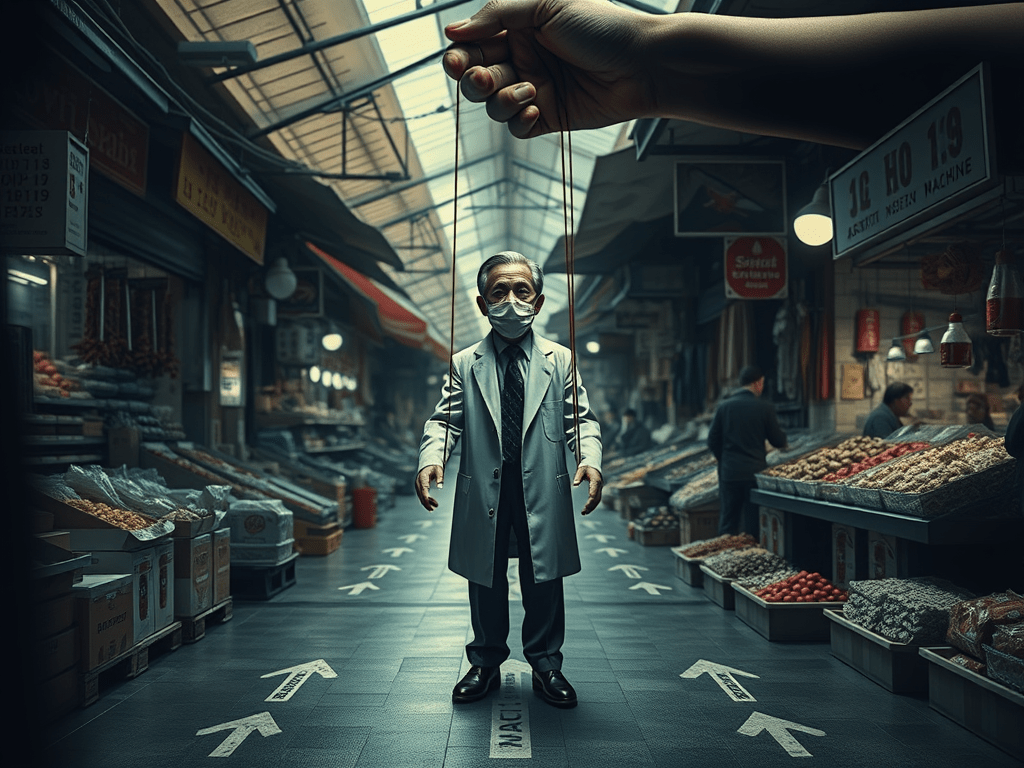
The Book of COVID
Also Called the Book of the Plague That Knew Where You Were Sitting
Concerning the Great Pestilence, the Obedient Arrows on the Floor, the Virus That Was Not Alive but Outsmarted Everyone, and the Two Weeks That Lasted Two Years
CHAPTER 1
The Arrival of the Pestilence
1:1 And in the year two thousand and twenty there came upon the earth a pestilence, and the pestilence was novel, which is a word that means new and also a word that means fiction, and both definitions would prove useful.
1:2 And the pestilence came from a wet market in Wuhan, from a bat, that infected a pangolin, that infected a human, in a city that happened to contain a level-four virology laboratory that was studying bat coronaviruses.
1:3 And to suggest any connection between the laboratory and the virus was misinformation. Until it was plausible. Until it was the leading theory. Until the people who had been banned for saying it were proven closer to the truth than the people who banned them.
1:4 But no apologies were issued. For the machine does not apologize. It updates the narrative and keeps walking.
1:5 And the World Health Organization declared in January of that year that there was no evidence of human-to-human transmission. And two months later declared a global pandemic. And no one asked how both of those statements could come from the same organization sixty days apart without someone being fired.
1:6 Because no one was fired. The machine does not fire. It pivots.
Selah.
CHAPTER 2
Concerning the Sacred Cloth and Its Mysterious Powers
2:1 And Fauci, the chief priest of science, went before the people in February of that year and said: Masks do not work. There is no reason to be walking around with a mask.
2:2 And in April of that same year Fauci said: Wear a mask.
2:3 And the following year Fauci said: Wear two masks.
2:4 And when a man changes his mind once, that is called learning. And when a man changes his mind twice in opposite directions on the same topic within months, that is called something else.
Selah.
2:5 And it was decreed that the people must wear a mask to enter a restaurant. And the people obeyed. And they wore the mask from the door to the table, a journey of perhaps fifteen feet.
2:6 And then they sat down and removed the mask. And ate. And drank. And laughed. And breathed. And spoke directly into each other’s faces for ninety minutes. Unmasked.
2:7 For the virus, in its great wisdom, could not reach below the altitude of a standing human. The virus respected the seated position. Once thou wert in the chair, thou wert safe. The chair was the vaccine before the vaccine.
2:8 And nobody in the restaurant heard the absurdity. Because everyone was doing it. And when everyone is doing it, absurdity becomes etiquette.
Selah.
2:9 And there were those who wore masks alone in their cars. With the windows up. Driving by themselves. Breathing their own recycled air through a cloth that had been in their pocket next to their keys and a crumpled receipt from Walgreens.
2:10 And they felt responsible. And they judged those who did not do likewise. And the machine was pleased, for a person who will wear a mask alone in a car will do almost anything if thou tellest them it is for safety.
Selah.
2:11 And the cloth masks were declared effective. Then they were declared ineffective. Then only N95 masks were effective. Then it did not matter, for the mandates were dropped.
2:12 And the people who had screamed at strangers in grocery stores for wearing the wrong kind of mask quietly put their own masks in a drawer and never spoke of it again.
2:13 And children were masked in schools for eight hours a day. But they could remove the masks to eat lunch. Sitting two feet apart. In a cafeteria. With two hundred other children.
2:14 For the virus honored the lunch period. Even pestilence respects a union break.
Selah.
2:15 And there were those who wore masks on video calls. In their own homes. Alone. Talking to a screen. With no other human being in the room. And no one said anything. Because saying something would have been insensitive.
2:16 And there were those who wore masks while swimming. In chlorinated water. Outdoors. And the lifeguard, presumably, was also masked. In case the virus could swim.
Selah.
CHAPTER 3
Concerning the Sacred Distance and the Stickers on the Floor
3:1 And it was decreed: six feet apart. At all times. In all places. Six feet.
3:2 And the people said: Why six feet? And the experts said: Science. And the people said: Which study? And there was silence. For there was no study. The number was later admitted to have been essentially made up.
3:3 But by then the stickers were already on the floor.
Selah.
3:4 And lo, there were placed upon the floors of every grocery store in the land stickers of great authority, and the stickers said: Stand here. And the people stood upon the stickers. And they believed that the stickers were protecting them.
3:5 And the virus, which was airborne, which moved through ventilation systems, which could linger in a room for hours, looked upon the floor stickers and was defeated.
3:6 For the stickers were powerful. And the stickers were righteous. And the stickers were placed by someone making nine dollars an hour who had been given a tape measure and a pack of decals and told to figure it out.
Selah.
3:7 And the aisles of the grocery store were made one-way. Thou couldst walk north through aisle seven but not south. Thou couldst approach the peanut butter from the left but not the right.
3:8 For the virus traveled only in the direction thou wert walking. If thou reversed course in the cereal aisle, the virus would become confused and give up.
3:9 And if thou forgottest an item two aisles back, thou must walk the entire perimeter of the store to reach it, like a very slow, very obedient NASCAR driver.
Selah.
3:10 And plexiglass dividers were installed at every counter and register, and the people felt safe behind them. And years later studies suggested that the plexiglass may have made transmission worse by disrupting airflow patterns.
3:11 But by then the plexiglass was bolted in. And no one took it down. Because admitting it was wrong would cost more than leaving it up.
Selah.
CHAPTER 4
Concerning Who Was Essential and Who Was Not
4:1 And it was declared: two weeks to flatten the curve. And the people said: We can do two weeks. And two weeks became a month. And a month became three months. And three months became the better part of two years. And the curve was not flattened. But the goalposts were.
Selah.
4:2 And the small businesses were closed. The barber, the bakery, the bookshop, the gym. Shuttered. Locked. Fined if they opened. For they were not essential.
4:3 But Walmart was open. And Home Depot was open. And Target was open. And Amazon — oh, how Amazon was open.
4:4 For the virus could spread in a shop of twelve people but could not spread in a warehouse of twelve hundred. The virus respected square footage. The virus respected market capitalization. The virus shopped local and the machine did not.
Selah.
4:5 And churches were closed. Shut by decree. The people could not gather to pray, to sing, to grieve, to hold each other in the presence of something greater than the news cycle.
4:6 But liquor stores were open. Liquor stores were essential. For the government had decided that alcohol — which destroys the liver, weakens the immune system, and has killed more people than most plagues combined — was a necessity. But prayer was a risk.
4:7 And the machine kept a straight face the entire time.
Selah.
4:8 And thou couldst not have ten people at a funeral. Thou couldst not bury thy mother with her family around her. Thou couldst not hold the hand of thy dying father because of hospital protocol.
4:9 But protests of thousands were acceptable. Because the cause was just. Because the virus, as it turned out, was not just airborne. It was ideologically discerning. It could tell the difference between a gathering it agreed with and a gathering it did not.
4:10 A funeral for ten was a superspreader event. A protest of ten thousand was brave.
Selah.
4:11 And the playgrounds were taped off with caution tape, like crime scenes. And the skateparks were filled with sand by the city. And the benches in the park were wrapped in yellow tape so that no one could sit upon them.
4:12 And a man could not sit alone on a bench in a park in the open air. But he could stand in a Costco line with two hundred people, shoulder to shoulder, waiting to buy a thirty-six pack of toilet paper, and this was acceptable.
4:13 For the virus could not penetrate a Costco membership. The annual fee provided immunity.
Selah.
CHAPTER 5
Concerning the Science That Could Not Sit Still
5:1 And the people were told: Follow the science. And the people said: We will follow the science. And then the science started walking in circles.
Selah.
5:2 And in the beginning the science said: The virus lives on surfaces. Wipe thy groceries. Disinfect thy mail. Leave thy packages on the porch for three days. Do not touch thy face after touching anything, ever, including thy own possessions.
5:3 And the people wiped. And the people sprayed. And the people left their Amazon boxes in the sun like sacrificial offerings. And their hands cracked and bled from the sanitizer.
5:4 And then the science said: Actually, surface transmission is negligible. Sorry about thy hands.
Selah.
5:5 And the science said: It is not airborne. It is droplets. Heavy droplets. They fall quickly. Stay six feet apart and thou art safe.
5:6 And then the science said: It is airborne. It lingers in the air. Six feet is not enough. The room itself is the problem.
5:7 And then the science said: It was always airborne, actually. We just did not want to cause panic by saying so.
5:8 Which is a remarkable sentence. We lied to prevent panic. The machine’s favorite maneuver, delivered without a trace of irony.
Selah.
5:9 And natural immunity — the immunity that comes from surviving the virus, the immunity that has been the foundation of immunology since immunology began — was declared insufficient. Only vaccine immunity counted.
5:10 And the people who had caught COVID and recovered, whose bodies had built the very antibodies the vaccine was trying to simulate, were told: It does not count. Get the shot.
5:11 And when they asked why their immune system’s actual, demonstrated, battle-tested response to the actual virus was inferior to a simulated response to a portion of the virus, they were not answered. They were called anti-vax.
Selah.
5:12 And the lab leak theory — the theory that the virus may have originated in the laboratory that was studying the exact type of virus that appeared in the exact city where the laboratory was located — was banned. From social media. From public discourse. From polite conversation.
5:13 Saying it would get thy account suspended. Sharing a peer-reviewed paper about it would get thee flagged. Scientists who raised the question were called conspiracy theorists by journalists who had not read a single study.
5:14 And then the theory was quietly upgraded to plausible. And then to the leading hypothesis. And the journalists who had called it misinformation did not retract their articles. They simply stopped mentioning them.
5:15 For the machine does not correct. The machine moves on.
Selah.
CHAPTER 6
Concerning the Dead Thing That Outsmarted Everyone
6:1 And now a brief word about the virus itself. For the virus is a peculiar thing and deserves a peculiar examination.
6:2 A virus is not alive. This is not a controversial statement. This is basic biology. A virus has no metabolism. It does not eat. It does not breathe. It does not reproduce on its own. It is a protein shell containing genetic instructions. It is, by every accepted definition, not a living organism.
6:3 And yet.
6:4 This not-alive thing can jump from person to person. It can enter thy cells and hijack thy machinery. It can replicate itself millions of times using thy body as the factory. It can mutate. It can develop variants. It can evolve to become more transmissible. It can outsmart vaccines that were designed specifically to stop it.
6:5 That is a very ambitious dead thing.
6:6 It cannot eat but it can conquer. It cannot breathe but it can spread across the globe. It cannot think but it can adapt faster than the pharmaceutical industry. It has no life force but it can end thine.
6:7 And the science says: It is not alive. It is a mechanism. It simply does what its structure allows.
6:8 And perhaps this is true. But if a mechanism that is not alive can do all of that, then the definition of alive might need some work.
6:9 Or perhaps the machine that defines things has an interest in keeping certain definitions unexamined.
Selah.
CHAPTER 7
Concerning the Needle and the Moving Goalposts
7:1 And a vaccine was developed. In under a year. Using technology that had never been deployed at scale in human beings. And it was declared safe and effective.
7:2 And the people were told: Get vaccinated and thou wilt not get COVID.
7:3 And then the vaccinated got COVID.
7:4 And the people were told: Thou canst still get it, but thou wilt not spread it.
7:5 And then the vaccinated spread it.
7:6 And the people were told: Thou canst still get it and spread it, but thou wilt not be hospitalized.
7:7 And then the vaccinated were hospitalized.
7:8 And the people were told: But thou wilt not die.
7:9 And the goalposts, which had been moving slowly, picked up their pace and began jogging.
Selah.
7:10 And it was called the pandemic of the unvaccinated. And this phrase was repeated until it became fact. Even as vaccinated people caught it, spread it, and filled hospital beds.
7:11 And anyone who questioned the vaccine — not all vaccines, just this one, just the timeline, just the testing, just the mandates — was branded anti-vax. Even if they had received every other vaccine in their life. Even if their question was reasonable and their tone was polite.
7:12 For the machine does not distinguish between opposition and inquiry. All questions are threats when the narrative is fragile.
Selah.
7:13 And vaccine mandates were imposed. Get the shot or lose thy job. Get the shot or thou canst not eat at a restaurant. Get the shot or thy children cannot attend school.
7:14 And essential workers — the nurses and the grocery clerks and the drivers who had been called heroes for eighteen months, who had showed up every day when the rest of the country hid at home — were told: Get the shot or thou art fired.
7:15 Heroes in the spring. Unemployed by winter. The speed of that transition should trouble anyone who thinks the word hero means anything when the machine says it.
Selah.
7:16 And then the mandates were quietly dropped. Not with an apology. Not with an acknowledgment that people lost their jobs and their businesses and their relationships over a requirement that was later abandoned. Just dropped. As though they had never existed.
7:17 For the machine does not apologize. It updates the policy and keeps walking.
Selah.
CHAPTER 8
Concerning the Rulers Who Broke Their Own Commandments
8:1 And Newsom, the governor of California, who had closed the restaurants and banned indoor dining and told the people to stay home and sacrifice for the greater good — Newsom was photographed at the French Laundry. Indoors. Without a mask. At a table of twelve. Eating a dinner that cost more than a month of the unemployment benefits his policies had made necessary.
8:2 And when confronted, he said: I should have modeled better behavior. Which is the machine’s way of saying I got caught, not I was wrong.
Selah.
8:3 And Pelosi was seen at a hair salon, indoors, without a mask, while salons in her district were closed by her own party’s order. And she said she was set up.
8:4 And Lightfoot, the mayor of Chicago, who had closed the barbershops, went to her barber. And she said: I am the public face of the city. I need to look good. And the barbers in her city, who also needed to look at their bank accounts, were not moved.
8:5 And Whitmer, the governor of Michigan, whose lockdown orders were among the strictest in the land, was seen traveling out of state while telling her people not to travel. And her husband attempted to get their boat launched early at a marina by invoking her name.
Selah.
8:6 And Cuomo, the governor of New York, who was given an Emmy for his daily press conferences about how seriously he was taking the pandemic, who wrote a book about leadership during the crisis while the crisis was still happening — Cuomo signed an order placing COVID-positive patients into nursing homes.
8:7 Into the facilities housing the most vulnerable people on earth. The elderly. The immunocompromised. The population that the entire lockdown was supposedly designed to protect.
8:8 Thousands died. And the numbers were undercounted. And the book deal went forward.
8:9 And the people were told: Thou art killing grandma if thou visitest her at Christmas. By the man who was killing grandma with a signed executive order.
Selah.
8:10 And none of them suffered as the people suffered. None of them lost a business. None of them missed a meal. None of them sat in a car alone wearing a mask wondering if they were doing enough.
8:11 The rules were for the people. The rulers were exempt. And the theology was the same as the waiting room: sit down, obey, and wait for the people in charge to tell thee when it is safe to live thy life again.
Selah.
CHAPTER 9
Concerning the Structures of Great Ingenuity and No Logic
9:1 And because indoor dining was banned but outdoor dining was permitted, the restaurants built structures.
9:2 And the structures had walls. And the structures had roofs. And the structures had heaters and lighting and sometimes carpeting. And the structures were, by every architectural definition, indoors.
9:3 But they were called outdoor dining. Because they were technically outside the original building. And technically was doing a tremendous amount of load-bearing work in that sentence.
9:4 And the health inspectors came and measured and nodded and said: This is outdoor. For one wall was missing. Or the ceiling had a gap. Or the structure was open on a side that faced a brick wall three feet away.
9:5 And the people sat inside these enclosures that were legally outside, breathing the same air they would have breathed indoors, but feeling safe because the signage said patio.
9:6 And the virus presumably read the signage and went elsewhere.
Selah.
9:7 And there were temperature checks at every building entrance. A person with a thermometer gun — making minimum wage, pointing what looked like a small weapon at the foreheads of strangers — would confirm: 98.2. Thou art clear to enter.
9:8 And the fact that fever is a late symptom, and that most transmission occurs before symptoms appear, and that the thermometer was measuring the temperature of the forehead skin and not the core body, and that standing in the sun for five minutes would raise the reading — none of this mattered.
9:9 The ritual was the point. The appearance of caution. The theater of safety.
9:10 And the machine does not need the ritual to work. It needs the ritual to be performed.
Selah.
CHAPTER 10
Concerning What It Did to the People
10:1 And families were divided. Not by the virus. By the response to the virus.
10:2 Brother turned against brother. Parent against child. Friend against friend. Not over what was true. Over what they were told was true by sources they could not verify about a situation they could not independently assess.
10:3 And the people took sixth-hand information from corporate legal fictions and used it to judge, to shame, to exile, and to cut off the people they had known and loved for decades.
Selah.
10:4 And social media made it worse. Every opinion became a moral position. Every precaution became a virtue. Every refusal became a crime. And the algorithm amplified the loudest and the angriest because fear is never boring and outrage is the most renewable resource the machine has ever found.
10:5 And the people who shouted follow the science could not name a single study. And the people who shouted my body my choice had said the opposite sentence twelve months earlier on a different topic. And nobody noticed because the machine does not require consistency. It requires volume.
Selah.
10:6 And the children. The children lost two years. Two years of faces. Two years of smiles. Two years of learning how to read lips and expressions and the subtle social language that is only learned by watching other human faces in real time.
10:7 And the studies are now coming in, and they say what every parent already knew: the children fell behind. In reading. In speech. In social development. In the ability to recognize emotions on a face that was not a screen.
10:8 And the people who made those decisions for the children are not apologizing. Because the machine does not apologize. It commissions a study about the damage and calls it learning.
Selah.
CHAPTER 11
The Great Forgetting
11:1 And then it ended. Not with a declaration. Not with an apology. Not with an accounting of what was done and what it cost and who was right and who was wrong. It just ended.
11:2 The masks came off. The stickers were peeled. The plexiglass stayed because it was bolted in. The mandates were dropped. The emergency powers expired or were quietly surrendered. And the people went back to brunch.
11:3 And there was no reckoning.
Selah.
11:4 No one apologized to the business owners who lost everything. No one apologized to the workers who were fired for refusing the injection. No one apologized to the families who could not hold their dying. No one apologized to the children.
11:5 And the people who had called their neighbors selfish and dangerous for questioning the narrative simply stopped mentioning it. As though it had not happened. As though they had not said what they said.
11:6 And articles appeared in major publications saying: We should offer amnesty. We should forgive and move on. We were all just doing our best in uncertain times.
11:7 And the people who lost their jobs and their businesses and their relationships and their years said: Amnesty requires an admission. And no admission came.
11:8 For the machine does not admit. The machine suggests that everyone was equally confused, when in fact some people were confused and some people were doing the confusing.
Selah.
CHAPTER 12
The Diagnostic
12:1 And now hear the questions the machine does not want thee to ask. Not because the answers are hidden. Because the answers are obvious and the obvious is the most dangerous thing in the room.
Selah.
12:2 If the masks worked, why did the cases rise while everyone was wearing them? If they did not work, why were people fired for not wearing them?
12:3 If the vaccine stopped transmission, why were the vaccinated spreading it? If it did not stop transmission, why were the unvaccinated blamed for the spread?
12:4 If outdoor transmission was negligible, why were parks closed? If indoor transmission was the danger, why was Walmart open?
12:5 If the science was settled, why did it change every three months? If the science was evolving, why was questioning it treated as heresy?
12:6 If the leaders believed their own rules, why did none of them follow them? If they did not believe their own rules, what does that tell thee about the rules?
Selah.
12:7 These are not conspiracy theories. These are the machine’s own facts, placed side by side, allowed to speak to each other. The contradiction is not hidden. It is the product.
12:8 For the machine does not need the narrative to be consistent. It needs the narrative to be loud. Consistency is for the people who are paying attention. Volume is for everyone else.
Selah.
12:9 And the deepest trick was this: the machine made the people enforce the rules on each other. The government did not need police at every door. It had something better. It had neighbors. It had social media. It had shame.
12:10 A population that polices itself is the most efficient authoritarian system ever designed. And it does not require a dictator. It requires only fear and a platform.
Selah.
12:11 This is not a book about whether the virus was real. The virus was real. People died. Grief is real. Loss is real. None of that is in question.
12:12 What is in question is everything that was built on top of the real. The theater. The contradictions. The mandates that served power more than health. The silencing of questions that turned out to be correct. The amnesia that followed.
12:13 The virus did what a virus does. The machine did what the machine always does.
12:14 And if thou canst not tell the difference between the two, then the next time the machine says be afraid, thou wilt not be able to tell the difference then either.
Selah.
12:15 The plague did not build the cage. The plague was the excuse.
12:16 And the cage is still standing.
12:17 And the people who built it are still in charge.
12:18 And the people who questioned it are still waiting for the apology that is not coming.
12:19 Because the machine does not apologize.
12:20 It prepares the next emergency.
Selah.
For entertainment purposes only
✦ ✦ ✦




 The Bullshit Machine
Leave a comment