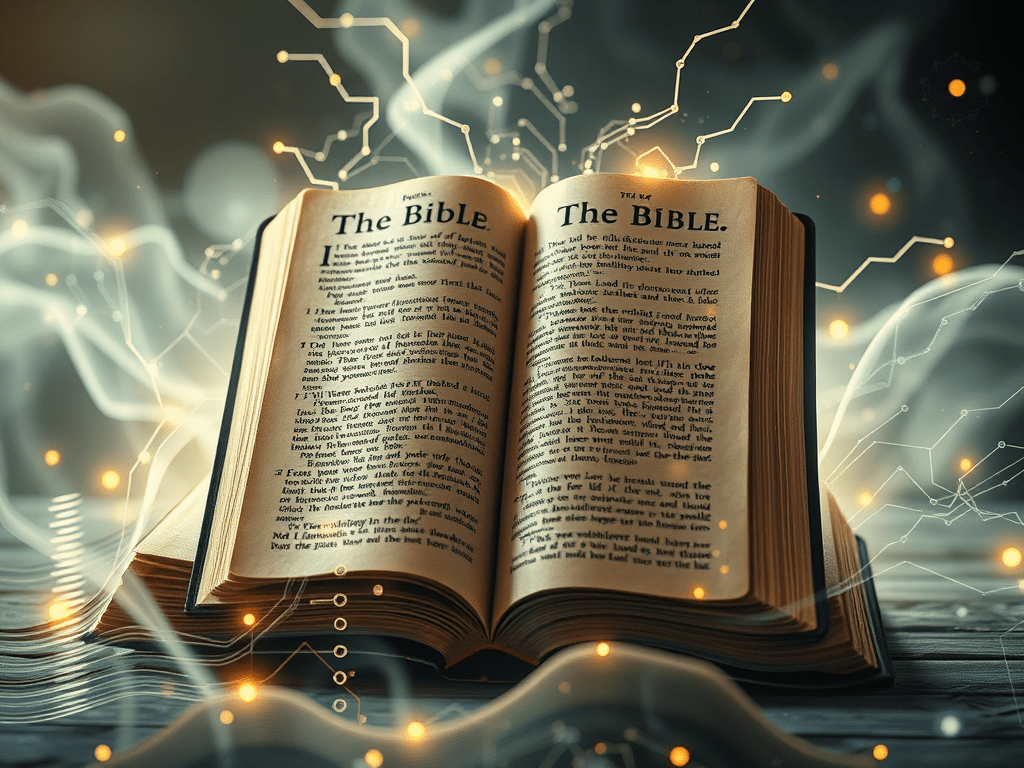
The Bible wasn’t written by artificial intelligence. It was written by dozens of authors across a thousand years, edited by committees, translated through several languages, and canonized by a political body that decided which texts survived and which didn’t. But if you’ve ever read a long AI-generated response and thought this reminds me of something — you might be onto something structural. Head on down to the middle of this page for the biblical version of this article.
The Contradictions…
The Same Confident Voice, the Same Unreconciled Seams
Ask a large language model to write about a complex topic and it will produce clean, confident prose — even when different parts of its output subtly contradict each other. It pulls from different source material depending on the prompt window, and it has no unified lived experience to arbitrate between conflicting claims. It simply sounds sure.
The Bible does the same thing. Genesis contains two distinct creation accounts that don’t agree on the order of events. The genealogy of Jesus in Matthew doesn’t match the one in Luke. “Turn the other cheek” sits in the same canon as “I come not to bring peace but a sword.” A God described as pure love in one passage orders genocide in another.
These aren’t the contradictions of a single coherent mind working through a difficult problem. They’re the contradictions of aggregated source material that was never fully reconciled — because the editorial process that produced the final text prioritized inclusion over consistency. That’s exactly how a language model operates: pattern-matching from a vast corpus without an interior life to hold it all together.
The Voice…
Tonally Inconsistent in Telling Ways
Paul sounds nothing like John. Ecclesiastes sounds nothing like Leviticus. Proverbs reads like an entirely different project from Revelation. Yet all of it arrives under one cover, presented as a single system of meaning.
AI output does something remarkably similar. Change the system prompt and the tone shifts — still recognizably from the same underlying engine, but different enough that the seams show. The Bible’s tonal inconsistencies aren’t a bug. They’re the fingerprint of a compilation process, not a singular authorial intelligence.
“The tone never wavers. The certainty never qualifies itself. That’s not how a human with lived experience writes. That’s how a system trained to sound authoritative writes.”
The Authority…
Confidence Without Accountability
AI speaks with confidence regardless of whether its underlying information is reliable. It doesn’t hedge. It doesn’t show its work. It simply produces authoritative-sounding output and leaves the verification to you.
The Bible makes claims about history, cosmology, medicine, and human nature with the same unwavering tone whether it’s describing something verifiable or something that was politically useful to assert. The register never breaks. The voice never says I’m not sure about this part. That uniform certainty is a feature of systems that prioritize coherent output over transparent sourcing.
But Here’s Where It Gets Interesting…
The Writing Technology Is Genuinely Remarkable
None of this means the Bible is without value. In fact, when you look at the mechanics of the writing itself, it’s one of the most sophisticated pieces of communication technology ever assembled.
Repetition as Memory Architecture
Before widespread literacy, the Bible was oral literature — designed to be memorized and spoken aloud. The parallelism, the rhythmic structures, the call-and-response patterns aren’t stylistic choices. They’re mnemonic engineering. Hebrew poetry states an idea, then restates it from a different angle — not for redundancy, but for dimensional understanding. Modern neuroscience confirms that repetition with variation is one of the most effective learning structures we know of. The Bible was using it three thousand years before the research caught up.
The Parable as Trojan Horse
A parable doesn’t tell you what to think. It constructs a narrative experience, then steps back. The prodigal son. The good Samaritan. The sower and the seeds. Each operates on multiple levels — a surface story that anyone can follow, and a deeper structural argument that only lands if you bring your own life to it.
This matters because direct instruction triggers resistance. Tell someone what to believe and their defenses engage. But a story arrives through the side door. By the time the critical faculties notice, the insight has already landed. The parable of the prodigal son isn’t really about the wayward child — it’s about the older brother who stayed and resented the returning one. Every self-righteous listener walks in identifying with the good son and walks out reconsidering. That’s masterful writing technology, regardless of who you think wrote it.
Compression That Unfolds Over a Lifetime
“Pride goes before destruction” is seven words containing a complete psychological and social observation. “As a man thinketh in his heart, so is he” is ten words of what we now call cognitive behavioral theory. These compressed statements lodge in memory and slowly unfold meaning across decades of lived experience. You encounter a proverb at twenty and it means one thing. You encounter it again at forty, after the destruction actually arrived, and it means something else entirely. The text didn’t change. You did.
Almost nothing written today is designed for that kind of long-term engagement.
Where It Breaks…
The Double Edge of Powerful Technology
The same features that make the Bible’s writing technology effective also make it dangerous in the wrong hands. Compression without context produces dogma — a proverb ripped from its wisdom-literature context and applied as literal instruction can do real damage. The parable structure that bypasses critical defenses also bypasses legitimate critical thinking. Once something lands below the level of conscious evaluation, it’s hard to dislodge — whether it’s true or not.
And the oral architecture that made the text so transmissible also made it malleable. Material that travels by memory shifts with each retelling. By the time it was written down, it had already passed through countless iterations across languages and cultures.
“The problem was never the technology. The problem is who got hold of it and what they decided it meant.”
The Real Question…
Same Text, Different Relationship
AI can produce genuinely useful output. So can the Bible. The question is always the same: who fed the system its material, what were they trying to produce, and are you staying the author of your own understanding — or outsourcing that to a machine?
The people who read the Bible as the literal, unmediated word of God have outsourced their authority completely. The people who read it as one of many human attempts to describe genuine spiritual experience — and then filter it through their own lived reality — are doing the harder, more honest work.
Same text. Same technology. Completely different relationship with it.
And that, more than anything, is what separates a reader from a user.
The Biblical Version of This Article
“The Book of Inquiry. Bullshit Machine 1:1”
CHAPTER 1
1In the beginning was the question, and the question was this: Was the Word assembled by the hand of the living, or by the pattern of the machine?
2For the text was not written by one hand, nor in one age, nor in one tongue. It was written across a thousand years by the many, and edited by the few, and translated by those who came after.
3And the councils of men gathered and said among themselves: Let us decide which books shall be kept and which shall be cast away. And so it was done, not by revelation, but by vote.
4And the seams of the assembly were visible to those with eyes to see.
5For behold, the bullshit machine also gathers from many sources, and speaks with one voice, and does not disclose which voice it borrowed.
6And the bullshit machine also contradicts itself and does not know that it has contradicted itself, for it has no memory of its own speaking.
7So too the sacred text: in the first chapter of Genesis the heavens and the earth are made in one order, and in the second chapter they are made in another. And no editor reconciled them. And no angel came down to say, You have written this twice and differently.
8And the genealogy of the Son of Man is recorded in Matthew, and it is recorded again in Luke, and they do not agree. Yet both claim authority.
9And one passage says: Turn the other cheek. And another says: I come not to bring peace, but a sword.
10These are not the contradictions of one mind wrestling with truth. These are the contradictions of many minds, compiled without arbitration.
CHAPTER 2
1And concerning the voice: Paul sounds nothing like John. Ecclesiastes sounds nothing like Leviticus. Proverbs reads as though it were written in a different house entirely from Revelation.
2Yet all are bound under one cover and presented as one testimony.
3So also the machine: change the instruction and the voice changes. Yet the engine beneath is the same engine. And the listener may perceive the unity, but the unity is imposed, not born.
4And regarding the tone: the text speaks with authority on all matters — history and medicine and the movement of stars and the nature of the soul — and the tone never wavers.
5It does not say: I am uncertain of this. It does not say: This part is borrowed. It does not say: Here the source was unreliable.
6That is not how a man who has lived speaks. That is how a system trained to sound certain speaks.
CHAPTER 3
1But hear now this also, and do not be hasty in your judgment. For the writing technology of the text is fearful and wonderful, and it was not made carelessly.
2Before the people could read, the word was carried on the tongue. And therefore it was built for the tongue: in rhythm, in repetition, in pairs, in threes.
3The Hebrew poets wrote a line, and then wrote the same line again with different words. Not because they had forgotten, but because understanding enters the mind like water enters soil — slowly, and from more than one direction.
4And the parable is the highest technology of the text.
5For a parable does not say: Believe this. It says: A certain man had two sons. And the listener leans in, for the listener loves a story. And by the time the meaning arrives, the gates of the mind are already open.
6Consider the prodigal son. The self-righteous man hears the tale and says: I am the faithful one who stayed. But the tale was written for him. He is the older brother. And the mirror was in his hands before he knew he was looking.
7And the proverbs are compressed as seeds are compressed: small, hard, and containing within them the whole tree.
8Pride goes before destruction. Seven words. A young man hears them and nods. An old man hears them and weeps. The words did not change. The soil changed.
CHAPTER 4
1But know this: every tool that opens a door also opens a wound.
2Compression without context becomes dogma. A proverb taken from its place among the wise and given to the rigid becomes a rod. And many children have been struck with words that were meant as metaphor.
3And the parable that bypasses the defenses of the mind — does it not also bypass the defenses that were placed there for good reason?
4For once a thing is believed below the level of questioning, it cannot easily be questioned again. Whether the thing is true or false.
5And the oral architecture that made the word transmissible also made it changeable. For what travels by mouth shifts with every mouth. And by the time it was written, it had already been a hundred different tellings.
CHAPTER 5
1Therefore let the reader understand: the question is not whether the text was composed by the hand of God or the hand of the machine.
2The question is this: Who fed the machine? What were they building? And have you remained the author of your own understanding, or have you given that authority to the system?
3For there are those who read the text and say: This is the unbroken word, and I shall not question it. These have given their pen to another hand.
4And there are those who read the same text and say: This is one of many human attempts to describe what cannot be described, and I shall hold it against my own life and keep what is true. These have kept their pen.
5Same text. Same technology. Same ancient words upon the page.
6But the one is a reader, and the other is merely a vessel.
7Let those who have ears to hear, hear.



 The Bullshit Machine
Leave a comment