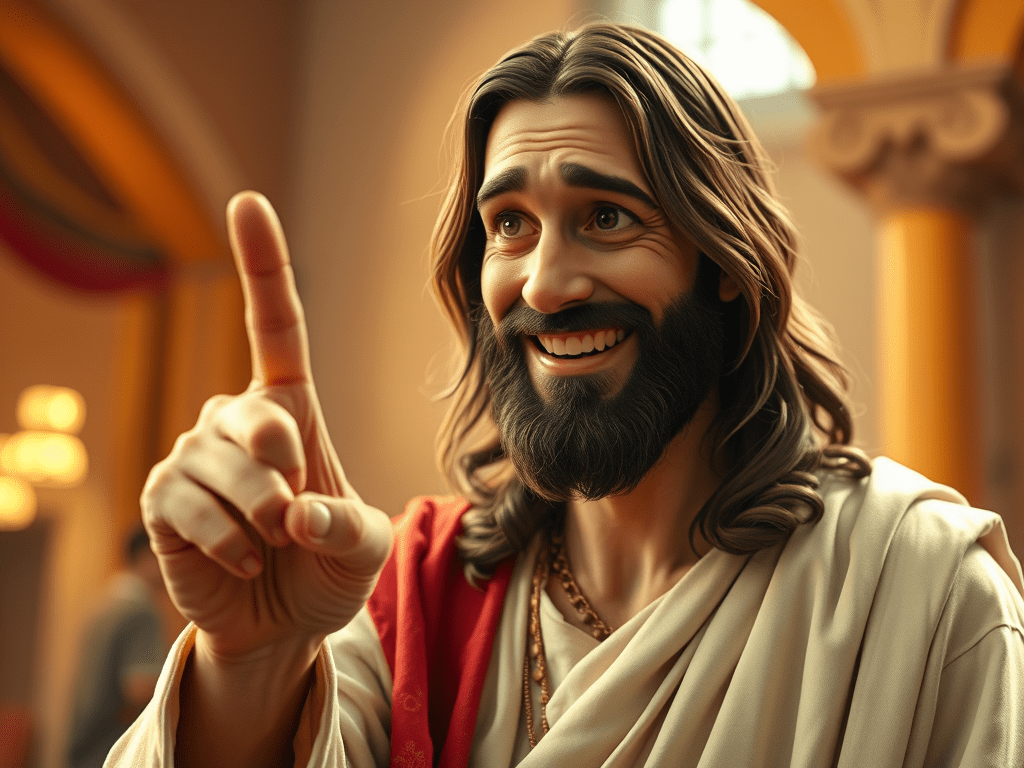
These articles are written in the style of the Bible on purpose — not to mock scripture and not to make a religious statement. The Bible is one of the most sophisticated pieces of communication technology ever assembled. Its rhythmic structure, its compression, its use of parallelism and parable — these are tools that were designed to bypass the part of the brain that argues and land meaning in the part that remembers. I use that same technology here because it works. Complex ideas about conditioning, psychology, and self-awareness hit differently when they arrive in a cadence the nervous system already recognizes. It’s also fun. Humor opens doors that lectures keep closed. If you’re smiling while something lands in you that you didn’t expect to feel — that’s the technology doing what it was built to do. We’re not rewriting the Bible. We’re borrowing the delivery system. Because the delivery system is genuinely brilliant, and the information deserves a vehicle that can carry it past the defenses.
The Book of Jerking
Also Called the Book of the Closed Loop
Concerning the Solitary Practice, the Glowing Scroll,
and the Conditioning of Men Who Trained Themselves
to Want What Cannot Want Them Back
CHAPTER 1
The Superstimulus and the Frictionless Reward
1:1And there came upon the land a new thing — a scroll that glowed, and upon the scroll were images of the act of union, performed by strangers, available at all hours, requiring nothing of the viewer but his attention and his hand.
1:2And the scroll was free. And the scroll was infinite. And the scroll was private. And these three qualities together were more dangerous than any one alone.
1:3For the body of man was built for a world of limited novelty, where access required effort, and intimacy required risk, and climax required another person who could say no.
1:4And the scroll removed all of these. It removed the effort. It removed the rejection. It removed the uncertainty. It removed the other person entirely.
1:5And what remained was reward without exposure. Pleasure without vulnerability. Climax without being known.
1:6And the nervous system of man, which cannot tell the difference between what is real and what is vividly simulated, adapted accordingly.
Selah.
CHAPTER 2
Concerning the Wiring and What It Replaces
2:1And the brain, which learns what it is fed, learned this: arousal comes from novelty. From switching. From escalation. From watching. Not from touch. Not from breath. Not from the slow negotiation of two nervous systems learning each other.
2:2And the man who trained upon the scroll found that the woman before him — with her pauses and her pace and her actual humanity — could not compete with the scroll’s parade of frictionless variety.
2:3And this was not because the woman was insufficient. It was because the training set was inhuman. And the man had calibrated himself to a standard that no living person was designed to meet.
2:4And the energy that could have driven him toward risk, toward courtship, toward the terrifying act of being known by another — that energy was discharged nightly, alone, into a tissue, and was gone by morning.
2:5And the system learned: reward does not require exposure. And a man who learns this lesson stops exposing himself to the very things that would grow him.
Selah.
CHAPTER 3
The Peeping Tom and the Spectator
3:1And hear now this, for it is the part men do not wish to hear.
3:2The scroll trains the man not as a lover but as a watcher. He does not participate. He observes. He consumes. He sits outside the act and peers in, and his arousal becomes the arousal of the audience, not the performer.
3:3And when that man enters a bed with a woman who is real, his body is present but his arousal is still seated in the audience. He watches himself. He monitors the performance. He runs the scene against the template. And the woman feels this.
3:4She does not say: Thou watchest too much of the scroll. She says: Something feels disconnected. I do not feel fully met. It feels as though I am being compared to something I cannot see.
3:5For a woman’s nervous system knows when a man is with her and when he is with a template. And no amount of technique can conceal the absence of presence.
3:6And the man says: I am here. And he believes it. But the wiring says otherwise. And the wiring does not lie.
Selah.
CHAPTER 4
The Loop and Its Function
4:1And the man built a loop, and the loop was efficient, and the loop went thus:
4:2Stress. Or boredom. Or loneliness. Or the feeling that had no name but sat heavy in the chest after dark.
4:3Then the scroll. Then the spike. Then the release. Then the brief quiet. Then the drop. Then the return of the feeling. Then the scroll again.
4:4And the loop became his anxiety regulator. And his sleep aid. And his boredom solution. And his loneliness substitute. All in one frictionless package, requiring nothing of him but a locked door and a connection to the network.
4:5And the problem was not the pleasure. The problem was the outsourcing. For if a man’s primary regulator is private sexual discharge, his nervous system never learns to tolerate tension. Or rejection. Or the slow friction of real intimacy. Which are the very capacities upon which adult love is built.
4:6And the man did not see this. For the machine told him it was self-care. And relaxation. And harmless. And normal. And the machine was running the loop, so of course it said these things.
Selah.
CHAPTER 5
What the Women Feel
5:1And the women said — not in the language of diagnosis but in the language of the body — Something is missing.
5:2The eye contact felt intermittent. The touch felt scripted. The escalation felt mechanical. The act felt aimed at a finish line rather than a shared experience.
5:3And the woman felt rushed. And evaluated. And required to perform an enthusiasm that the scroll had taught the man to expect. And she could not relax. And relaxation is the door through which female desire enters.
5:4And the man said: It is not related to the scroll. And the woman’s body said: It is.
5:5For the man trained on the scroll brings to the bed: technical competence, physical function, and emotional absence. And the woman describes this as: It’s good, but not deep.
5:6And that gap — between stimulation and presence — is the distance the scroll installed. And the woman lives on the far side of it, reaching across, wondering why she cannot touch him.
Selah.
CHAPTER 6
The Withdrawal and the Flatline
6:1And some men put down the scroll. And in the first days the machine raged.
6:2It said: This is pointless. This is extreme. It was not that bad. Moderation is the answer. And the man recognized the voice, for it was the same voice the machine always uses when it is threatened. Noble-sounding. Reasonable. Designed to keep the loop running.
6:3And in the days that followed there came a flatness. The desire departed. The arousal quieted. The body felt dull and the mind felt dim. And the man said: I have broken myself.
6:4But he had not broken himself. His nervous system, wired to high-intensity novelty, was simply waiting in the silence for something real to replace what had been taken away.
6:5And if he waited — through the flatness, through the boredom, through the surfacing of every uncomfortable feeling the loop had been burying — something began to return.
6:6Arousal from a voice. From a touch. From a presence. From the slow electricity of a real person standing close and meaning it.
6:7The brain, starved of the superstimulus, began to remember what it was designed for.
Selah.
CHAPTER 7
Concerning Relapse and the Shame That Feeds the Loop
7:1And many men who put down the scroll picked it up again. And the machine said: See? Thou art too weak. Thou hast failed. It is thy nature and thou cannot overcome it.
7:2But hear this: one slip does not rebuild the highway. It clears the overgrowth. The pathways weaken through disuse and strengthen through repetition, and a single lapse followed by correction does not erase what was built.
7:3The danger is not the slip. The danger is the shame spiral that follows. For the shame says: You have already fallen. You might as well keep falling. And the binge that follows the shame is what rebuilds the old circuit.
7:4The brain responds to patterns, not single events. And the man who falls once and stands immediately has lost nothing that cannot be regained.
Selah.
CHAPTER 8
The Diagnostic and the Door
8:1And now the question that the machine does not want thee to ask.
8:2After the act — after the climax, after the scroll is closed or the body is still — dost thou feel grounded and complete? Or drained and vaguely empty?
8:3That difference tells thee everything.
8:4Can thou stop for sixty days without the machine negotiating, rationalizing, and bargaining with thee every night? If not, that is not desire. That is dependency wearing the costume of desire.
8:5Does the woman in thy bed feel desired — or compared? If thou art honest, thou already knowest.
Selah.
8:6This is not a book of purity. This is not a sermon. This is not about what is righteous and what is sinful. The scroll is not evil. The body is not evil. The hand is not evil.
8:7But the loop — the frictionless, private, defended loop that replaces vulnerability with consumption and presence with spectatorship — that loop has a cost. And the cost is paid not by the man alone but by every person who tries to reach him through the wall the loop has built.
8:8The mature position is not abstinence as ideology. The mature position is awareness as practice. Know what the loop trains. Know what it replaces. Know what it costs. And then decide — not from habit, not from defense, not from the machine — but from the man underneath it.
8:9The closed loop opens from the inside.
8:10But thou must want to look at it first.
Selah.



 The Bullshit Machine
Leave a comment