
I’m almost done with my next book, “The Bullshit Machine 2: Navigating the Design of What We Are” and wanted to give a preview of what’s coming, so here is the Introduction. Enjoy!
Introduction
Something Is Running Your Life
And It Isn’t You
I want to ask you something before we get into any of this.
When was the last time you made a decision — a real one, not a reaction dressed up as a decision — that surprised you? Where you stopped, looked at what you were about to do, and chose something different than what the pattern was already pulling you toward?
Take a second and actually think about it.
If a specific moment came to mind quickly, good. That moment is important and we’re going to talk about why. If you had to think for a while, or nothing came to mind at all — that’s information too. That’s actually the more important answer. Because what it suggests is that most of your decisions haven’t been decisions at all. They’ve been outputs. The machine running its program and you watching it happen, calling it you.
That machine has a name in this book. I call it the Bullshit Machine.
The BSM, for short. Because we’re going to be spending a lot of time together.
What the Bullshit Machine Is
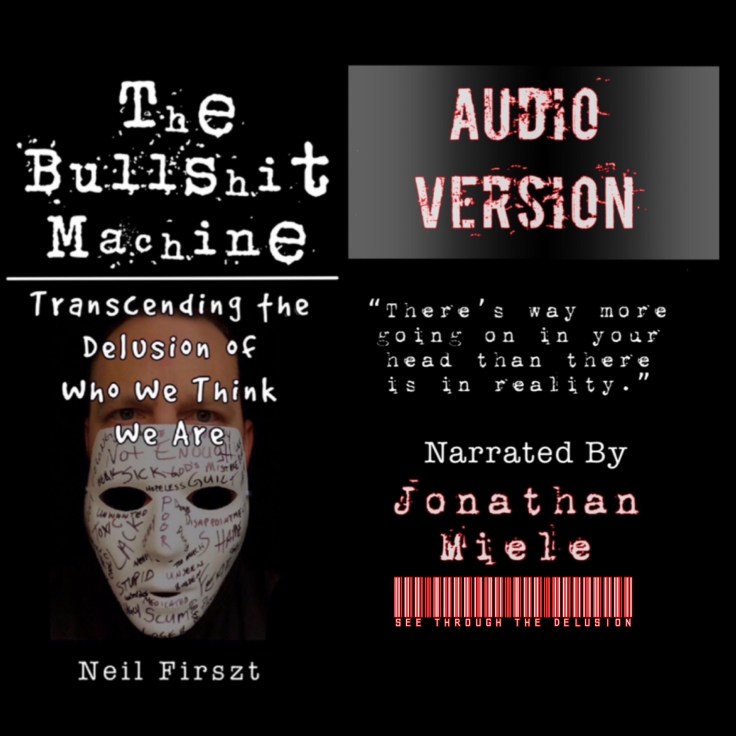
The Bullshit Machine is not your enemy. Just like it wasn’t in my first book, “The Bullshit Machine: Transcending the Delusion of Who We Think We Are.” I want to say that immediately and clearly, because the temptation when you name something is to make it the villain, and that is not what this is.
The BSM is the sum total of everything you were ever told to believe, every story you were handed about who you are and what you deserve and how the world works, every pattern that got grooved in before you were old enough to examine it, every defense mechanism that formed to protect you from something that no longer exists, and every habit that has been running so long you stopped noticing it was a habit at all. It’s the operating system underneath your operating system. The code that runs before you boot up.
It was built for you. Not by you. There is a difference.
Some of it was built by parents who were running their own bullshit machine and didn’t know it. Some by schools that were better at teaching compliance than curiosity. Some by religion, depending on how it arrived and how early. Some by media, advertising, social pressure, political narrative, and a cultural environment that is specifically engineered to keep you in a managed, predictable, and monetizable state. The people building those systems are not all evil. Most of them are just running their own bullshit machine. The machine replicates. That’s what it does.
Nobody handed you the instruction manual for the thing that’s been making your decisions. This book is a great place to start.
The BSM is also, to be very clear, not stupid. It is not unsophisticated. It is a remarkable piece of engineering built over decades of your actual lived experience, calibrated specifically to you, updated in real time, and absolutely convinced that it is keeping you safe. It has reasons for everything it does, and it will produce those reasons, eloquently and persuasively, the moment you challenge any of it.
That’s the part that makes this interesting.
A Question You’ve Probably Never Been Asked
Let me try something.
What do you actually believe you deserve?
Not what you’d say at a dinner party. Not the answer that sounds right. Not the version of this you’ve rehearsed. The quiet, subconscious, never-quite-said-out-loud answer. The one that shows up not in your words but in what you actually do when no one is watching and there’s no one to perform for.
The food you eat when you’re alone.
The quality of sleep you allow yourself.
The relationships you stay in past the point they make sense.
The opportunities you don’t take.
The version of your body you’ve decided is “good enough.”
People give themselves what they think they deserve. Not what they say they deserve. What they actually, quietly, at the operating system level believe is coming to them. The results in your life right now are not random. They are not bad luck. They are not the economy or your upbringing or the particular difficulty of your circumstances, though all of those are real. They are, in very large part, the output of a machine that has a very specific program running about what you’re worth.
When I was drinking 30 airplane bottles of vodka per day, that’s what I thought I deserved. Not consciously — I would have told you a very different story. But the results were honest. The results always are. The results are just biological feedback of your lifestyle.
The results in your life are not a mystery. They’re a readout. The machine is just showing you its work.
How We Got Here (The Short Version)
I spent over twenty years in the car business.
I say that not to credential myself but to give you context for the particular flavor of BS I have been marinating in for most of my adult life. The car business is a master class in the gap between what is true and what is being said, between what the system needs you to believe and what is actually happening. You learn to read it fast or it eats you. I read it fast. And somewhere in the process of reading it in that environment, I started reading it everywhere else too.
I’m not a doctor. Not a scientist. I have no peer-reviewed studies, no institutional credentials, no letters after my name. What I have is personal knowledge. I experienced the things in this book. I tried them because I needed them to work, not because a study told me to. And when they worked — when the unhealthiness disappeared and the clarity showed up and the machine got quiet for the first time in years — I started paying attention to why.
This book is the why.
It is also, in a way, a little bit of a dare.
What This Book Is Actually Doing
Most books about health and self-improvement are operating on the surface. Change this habit. Try this protocol. Follow these steps. The steps are usually fine. The steps are often even correct. But they treat the symptom and leave the machine untouched. Which is why the same person who successfully completed a ninety-day transformation is, eighteen months later, right back where they started and blaming themselves for a failure of discipline.
It was not a failure of discipline. It was a failure to address the operating system.
This book goes after the operating system.
The first half is about understanding what the machine is, how it was built, why it runs, and what keeps it running. Not so you can be angry about it. So you can see it. Because you cannot change what you cannot see, and you cannot see what you have been taught to call “just who I am.”
The second half is practical. Eight fundamentals — not tips, not hacks, not a program with phases and a companion app. Fundamentals. The kind that do not expire. The kind the machine hates because they work by removing the conditions the machine depends on, rather than adding more inputs to manage. Clean water. Quality salt. Movement. Fasting. Gratitude. Silence. Breath. And a few others that will make more sense when we get there.
The fundamentals are not complicated. That is the point and also the problem. The BSM does not respect simple things. The BSM wants a sixty-day protocol with proprietary phases and a tracking app, because that’s something it can manage and optimize and eventually abandon with a reasonable excuse. The boring answer doesn’t give the machine anything to do. Which is exactly why it works.
The bullshit machine loves complexity. Simplicity starves it. This book is going to be very simple and the machine is already annoyed about it.
Some Things This Book Will Not Do
It will not tell you what to believe.
It will not pretend that the systems around you are secretly benevolent and that you just need to engage with them more skillfully. It will not be polite about the ways those systems have been specifically designed to keep you dependent, distracted, and manageable. It will not use soft language for hard things.
It will not be for everyone. I say that without apology and without judgment. This book is for a specific kind of person who has reached a specific kind of moment — the moment where the bullshit machine’s choices have accumulated enough that calling them “my choices” has started to feel embarrassing. If you are not at that moment yet, you have the option to put this down and come back when you are. The information will still be here. The machine will have added to its case file in the meantime.
It will not give you a new identity to adopt. No labels, no tribes, no bumper stickers. The whole point is the opposite of that. You are not trying to become a Fundamentals Person or a BSM Aware Person or whatever the sales pitch would be called if we were using one, which we are not. You are finding out what is underneath the labels you already have. That thing underneath is the point. The fundamentals are just what clears the path to it.
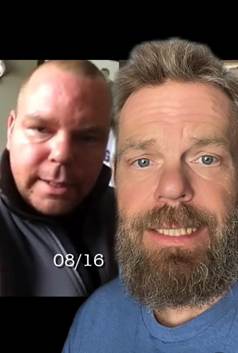
About Me and the Photo on This Page
The person on the left is me.
I want to be specific about what I was when that photo was taken, because the details matter. I was unhealthy in a way I had decided to manage with narrative rather than with change. I had a long list of reasonable explanations for why I was that way and why it was fine and why anyone who thought otherwise was missing the bigger picture. The BSM is nothing if not articulate. It produced fresh justifications on demand and I delivered them with conviction.
The person on the right is also me.
Same human. Same genetics. Same history. Different operating system.
I am not showing you these photos to impress you or to sell you a transformation. I am showing you them because the distance between those two pictures is not a diet. It is not a program. It is not discipline or willpower or finally finding the right information. It is what happens when you see the machine. When you stop letting it make the calls and start making them yourself. One fundamental at a time, one gap at a time, until the machine that built the person on the left no longer has enough authority to produce that result.
The right side of that photo is what I thought I deserved once the BSM stopped deciding.
I am writing this down because that process is repeatable. Not the specific results — your machine is yours, it has its own architecture, its own history, its own particular program. But the process of seeing it? That is available to anyone. It does not require a special aptitude. It requires a specific kind of honesty, and a willingness to be uncomfortable for long enough that the machine runs out of material.
That’s all it takes.
Which, now that I say it out loud, I realize is simultaneously the simplest and the hardest thing in the world.
One More Question Before We Start
What would your life look like if the machine’s program was not running it?
Not a fantasy. Not a vision board. Just — if the accumulated stories about what you deserve, what is possible, what is safe, what is you, were not the thing making the calls. If, for a moment, you got to see what was underneath all of that and make choices from there instead.
Do you have a picture of that?
If you do, hold onto it. We’re going to use it.
If you don’t — if the question drew a blank or produced a vague uncomfortable feeling with no image attached — that is the most important data point in this introduction. The machine has been so thorough that it has made the question itself feel unanswerable. Which is a remarkable achievement, if you think about it. The bullshit machine has convinced you that you don’t know what you actually want.
We are going to address that.
You didn’t build the machine. But you’re the only one who can turn it off. Let’s figure out where the switch is.
Here’s how this works. We start with belief — how it gets built, how it gets stuck, and how it goes from a useful tool to the thing running the whole show. Then presence — the one state in which the machine has no traction. Then the origin problem, which is the chapter that I expect will bother some people and clarify everything for others. Then facts and fiction — the basic architecture of how the machine distinguishes what is real from what is just a very convincing story. Then we get into coherence with the fictional systems man builds, what it looks like when a person’s inner and outer worlds are pointing in the same direction and why that is rarer than it should be. Then the fundamentals, which are the practical part, which is the part the machine is already strategizing ways to not do.
By the end, the bullshit machine will have been named, mapped, understood, and interrupted. Not destroyed. The machine is part of you and you do not destroy parts of yourself. But seen. And a machine you can see is a machine you can choose.
That’s the whole project.
Let’s go.



 The Bullshit Machine
Leave a comment