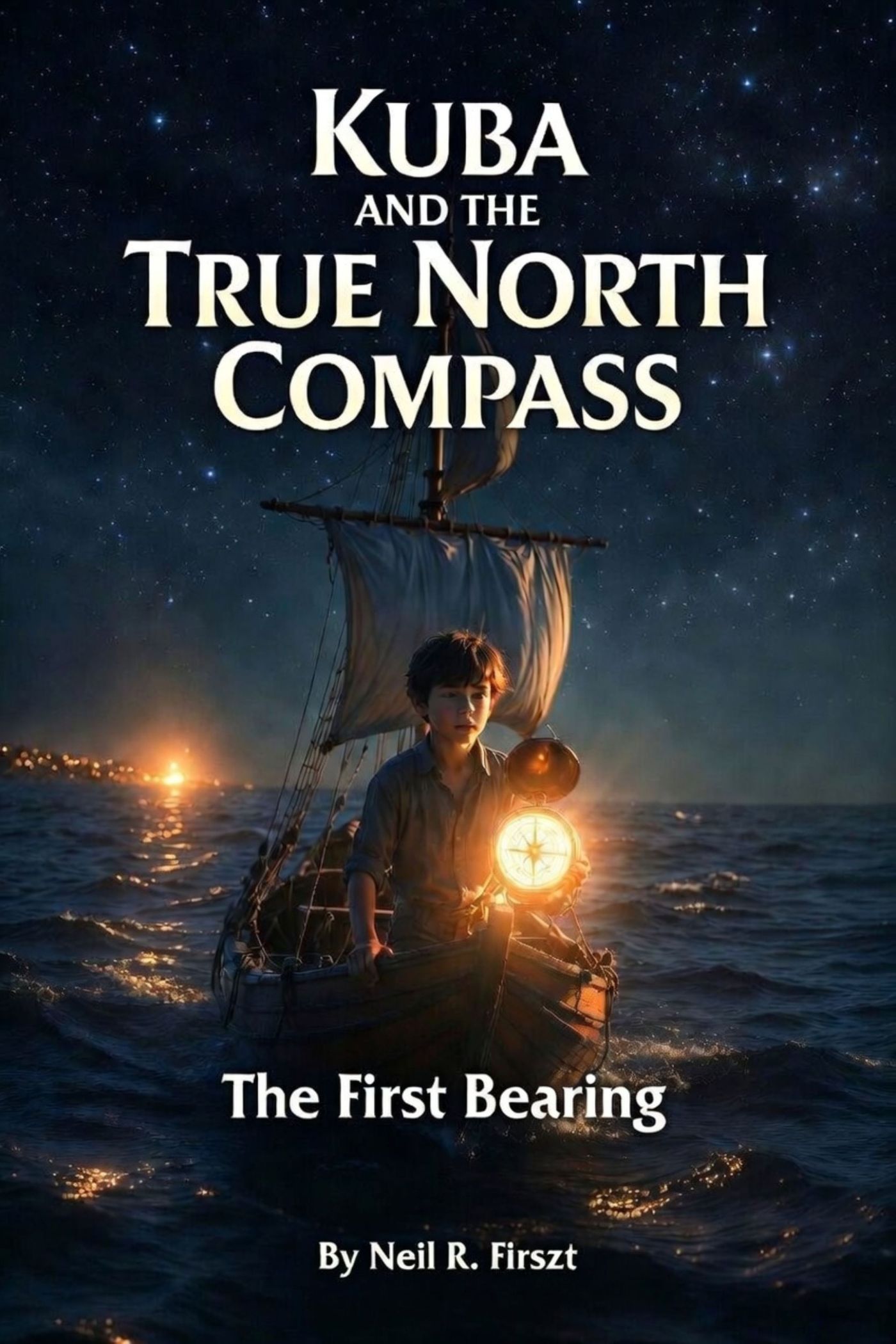
I just published the first book in a children’s series I’m writing. It’s available on Amazon NOW! Here are the details…
The Concept
Kuba is a middle grade book series about a ten-year-old boy named Kuba who discovers he has an internal compass — a built-in sense of what’s true that exists independently of peer pressure, popular opinion, or the emotional reactions of the people around him. The series follows Kuba through real situations kids actually face, showing how he uses his compass to navigate them honestly without being cruel, without caving into pressure, and without losing himself in the process.
The Structure
Each book has three distinct layers.
The real world is where the situation happens. School, home, the neighborhood. Real kids, real dynamics, real pressure.
The daydream navigation is where Kuba works it out. Whenever he has a safe quiet moment — walking home, in the back seat, in the backyard, on the bus — his mind goes to the water. He’s at the helm of his ship. The compass is in front of him. The rough water represents the pushback and pressure that comes from standing in what’s true. He navigates it in real time as he’s working out the situation. This is not escape. This is thinking. This is a kid learning to use his internal world as a tool rather than running from it.
The Land of the Bears is the destination. Kuba can only get there at night. In bed. At the end of the book after the day’s navigation is done. It is earned not given. The Land of the Bears is a place of high trust, high skill, and genuine community. Bears building structures, farming, welding, crafting airships, telling stories, doing real meaningful work with real hands for real reasons. Nobody is performing. Nobody is managing anyone else’s feelings. A capable, honest, trustworthy community doing what capable honest trustworthy communities do. Each visit Kuba learns something new — a trade, a skill, a capability. The treasure for following true north is never gold. It’s always something real he can actually do or know or build.
The Origin Story — Book One
Kuba is home when he spots a plate of cookies on the counter. Mom said they were for after dinner. She just left the room. Nobody would know.
He reaches for one.
Something stops him. Not fear of getting caught. Something quieter and more solid. A feeling that says not this way. He pulls his hand back. Puts the cookie down. And notices — for the first time — that the feeling that follows is different from anything he’s felt before. Not pride exactly. Something more foundational. Like standing on ground that doesn’t move.
That night he dreams for the first time of open water.
He is the captain of a small wooden ship. At the helm is a brass compass glowing faintly, pointing true north. He sails through rough water — waves that push and pull and try to knock him off course. The ship holds. The compass holds. And when the water calms he arrives at the Land of the Bears for the first time.
A bear sits him down and teaches him how to read the compass properly. How it will always lead him back here. How true north doesn’t move for anyone or anything. How the rough water is not the enemy — it’s just what the journey looks like when you’re going somewhere real.
Kuba wakes up knowing something he didn’t know the day before. Not a fact. A foundation.
Book Two and Beyond
Each subsequent book follows Kuba through a real situation — a conflict at school, a misunderstanding at home, a moment of social pressure, a choice nobody is watching him make. The daydream navigation happens in real time as he works through it. The Land of the Bears comes at night when the day is done and the compass has been followed and held.
The rough water gets rougher as the series progresses. The compass gets stronger. The trades learned in the Land of the Bears accumulate. Kuba becomes more capable, more grounded, and more genuinely useful to the people around him — not because he was told to be but because that’s what happens when someone consistently follows true north.
What It’s Really Teaching
That feelings are real but they are not facts about external reality.
That an angry reaction to a true thing doesn’t make the thing less true.
That working through something honestly in your own mind is a skill worth developing.
That capability — growing it, earning it, using it for something real — is the actual treasure.
That the internal compass was always there. It just needed to be noticed.
That true north doesn’t move.
The Intention
Much of what gets called self-help for adults is remedial work on things that should have been foundational in childhood. The ability to distinguish truth from consensus, the courage to stand in what you actually know, the trust in your own read of a situation — these are not complicated adult concepts. They are human fundamentals that got crowded out early by environments that rewarded agreement over honesty.
This series plants those fundamentals early. Not as lessons delivered by a narrator. As experiences lived by a kid who feels real, faces real situations, and works them out honestly using the tools he’s developing. The reader doesn’t get told what to think. They watch Kuba figure it out and recognize the same compass in themselves.
A kid who finds their own compass early — who learns to trust it and follow it through rough water — is a kid who is better equipped to navigate whatever the world brings without losing themselves in the process.




 The Bullshit Machine