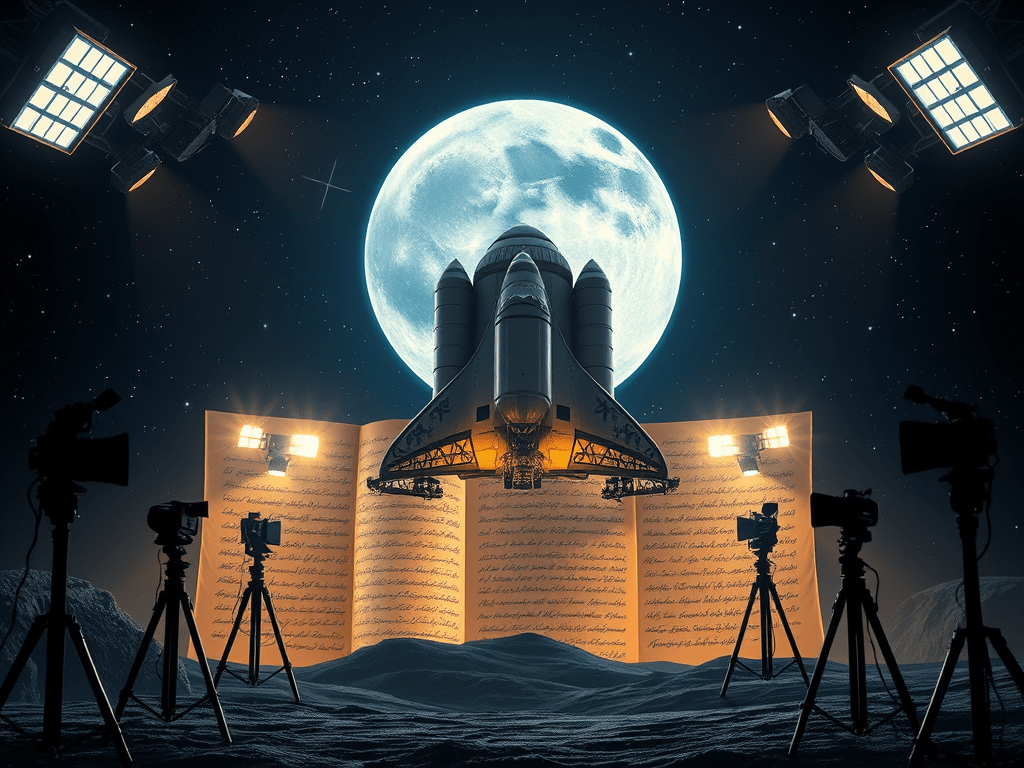
🌑
The Apocrypha of Apollo
The Book of Moon Landing
Being a faithful account of the journey to the heavens, the questions that attended it, and the machinery of belief that followed — written in the manner of the ancients.
Concerning the Decree, the Vessel, and the Ascent of Men
into a Place Where No Man Had Business Going
CHAPTER 1
The Decree of Kennedy
1:1 In those days there arose a leader in the land of America, and his name was Kennedy, and he was young and his hair was very good.
1:2 And Kennedy looked upon the Soviets, who had sent a man above the earth, and his heart was troubled. For the Soviets had gone up first, and this was not acceptable to the Americans, for whom being second was a kind of death.
1:3 And Kennedy stood before the people and said: We choose to go to the moon. Not because it is easy, but because it is hard.
1:4 And the people cheered, though many among them did not have indoor plumbing.
1:5And the treasury was opened, and twenty-five billion dollars was taken out and given unto the engineers. And in that generation, twenty-five billion dollars was a sum beyond reckoning.
1:6 And Kennedy did not live to see the thing accomplished. But the decree went forth, and it was not recalled. And this is perhaps the only government program in history that was completed on schedule, which is itself a kind of miracle.
CHAPTER 2
Concerning the Craft and Its Curious Dimensions
2:1 And the engineers built a vessel, and they called it Apollo, after the god of the sun, which is a strange name for a craft bound for the moon. But no one raised this point at the time, and so it stood.
2:2 And the vessel was three hundred and sixty-three feet tall, and it weighed six million pounds, and the computer that guided it had less memory than the device upon which thou now readest these words.
2:3 Yea, thy telephone hath more computing power than the whole of Apollo. Consider this and be amazed, or concerned. The choice is thine.
2:4 And atop this great rocket sat the Lunar Excursion Module, which the people called the LEM. And the LEM was the craft that would descend to the surface of the moon and return.
2:5 And let it be said plainly: the LEM looked like it was built in a backyard by a man who was not well. Foil and sticks and panels that appeared to be held together by faith and adhesive tape. The legs were wrapped in gold foil like a baked potato at a church dinner.
2:6 And this was the craft — this arrangement of tinsel and geometry that looked as though a strong wind would reduce it to parts — that was meant to land upon another world, support life, and launch again.
2:7 And it did. Apparently.
2:8 And the navigation was done in part by hand, with calculations written upon paper. And the margin of error for reentry into the Earth’s atmosphere was two degrees. Too steep and the craft would burn. Too shallow and it would skip off like a stone upon water and sail into the void forever.
2:9 Two degrees. With paper math. At seventeen thousand miles per hour.
2:10 And no one in the modern age can quite explain how they were this confident.
CHAPTER 3
The Ascent of Armstrong, the Silence of Collins,
and the Question of the Cameraman
3:1 And three men were chosen: Armstrong, who was quiet; Aldrin, who was not quiet; and Collins, who would orbit above and wait and receive almost no credit for this.
3:2 And Collins remained in the command module, circling the moon alone, and for forty-eight minutes of every orbit he passed behind the far side where no radio signal could reach him.
3:3 And in those minutes he was the most isolated human being who had ever lived. Farther from every other person than anyone in the history of the species.
3:4 And when they returned to Earth the reporters asked Armstrong about the surface, and they asked Aldrin about the experiments, and to Collins they said, more or less: And you were there also, yes?
Selah.
3:5 And Armstrong descended the ladder and placed his foot upon the dust and said: That’s one small step for man, one giant leap for mankind.
3:6 Or perhaps he said: That’s one small step for a man. The recording is unclear. And scholars have debated the presence of the article for over fifty years. A single syllable. Lost in static between the moon and the Earth.
3:7 And this is fitting, for even the most important sentence ever spoken off-world arrived with a textual contradiction.
Selah.
3:8 But now hear this, and hear it carefully, for no one speaks of it.
3:9 When Armstrong descended the ladder and placed his foot upon the moon — the first human foot upon another world — the camera was already outside, pointing up at him, recording.
3:10 Someone had to set up the camera first.
3:11 And no one asks who took the first steps on the moon to position the camera so that Armstrong’s first steps on the moon could be witnessed. Was it the cameraman? Was the cameraman first? Did the cameraman not count?
3:12 NASA says the camera was mounted on a panel of the LEM that folded down, and Armstrong deployed it by pulling a lanyard as he descended. And this may be so. But the footage is angled as though composed by someone who understood what the moment required.
3:13 And no one in the congregation asks the obvious question. And the obvious question is not answered because it is not asked.
The Book of Apollo
Concerning the Peculiarities, the Suits, the Broadcast,
and the Things That Make Men Pause
CHAPTER 4
Concerning the Garments and the Temperatures Thereof
4:1 Now let it be recorded that the surface of the moon is not a hospitable place. This is known. But let the numbers be spoken aloud, for they are instructive.
4:2 In the sunlight, the surface reaches two hundred and sixty degrees Fahrenheit. In the shadow, it falls to minus two hundred and eighty degrees Fahrenheit.
4:3 That is a swing of five hundred and forty degrees. On the same body. Sometimes within steps of each other, where the shadow of a boulder meets the light.
4:4 And the astronauts walked in this. In suits.
4:5 And the suits were made of — and let the record show this — twenty-one layers of fabric. Nylon and Teflon-coated fiberglass and Kapton and Mylar. Materials that, on Earth, one uses to wrap leftovers and line the attic.
4:6 And these twenty-one layers of glorified household materials maintained a livable temperature inside the suit across a five-hundred-and-forty-degree range. In a vacuum. With no atmospheric buffer.
4:7And if thou hast ever worn a winter coat that was too warm in the sun and too cold in the shade on a forty-degree day in October, thou might wonder at this.
4:8 For we have not produced a suit since that can do what those suits reportedly did. We send people to Everest and they die of cold in garments made with sixty years of additional technology. But in nineteen sixty-nine we had fabric that could handle five hundred and forty degrees of swing, and then we forgot how.
CHAPTER 5
Concerning the Broadcast Across the Void
5:1 And while the astronauts walked, the world watched. In real time. On television. A live broadcast from the surface of the moon to the living rooms of the Earth.
5:2 Two hundred and forty thousand miles. Live. In nineteen sixty-nine.
5:3 Now consider this: a television news van in that same era — and indeed in this era — carries many tons of broadcasting equipment. Generators, transmitters, amplifiers, antenna arrays. And this equipment broadcasts a signal over a distance of perhaps fifty miles to the nearest relay tower. And sometimes it doesn’t work.
5:4 And the news van does this on Earth, where there is atmosphere, and infrastructure, and a network of towers built at great expense across the land.
5:5 And the LEM — the foil-wrapped tree house made by heads of meth— broadcast a live television signal across two hundred and forty thousand miles of vacuum, through the Van Allen radiation belts, through the atmosphere, to Houston, and from Houston to the world.
5:6 With equipment that fit inside a vessel the size of a large closet.
5:7 And the signal was good enough to broadcast to six hundred million people simultaneously.
5:8 And if thou hast ever lost a cell phone signal in thine own living room, thou art permitted to sit with this for a moment.
CHAPTER 6
Concerning the Photographs and Other Wonders
6:1 And the flag. The flag ripples in the photographs, and there is no wind upon the moon. And NASA said: There is a horizontal rod sewn into the top of the flag to keep it extended. And this may be true, and the ripple is from the astronaut handling it. But the image remains troubling to the eye, for the eye knows what wind looks like.
6:2 And the shadows. In some photographs the shadows fall in different directions, and the skeptic says: This means multiple light sources, as on a film set. And the scientist says: This is because the ground is uneven. And both are making observations from the same image.
6:3 And the Van Allen belts. Between the Earth and the moon there are belts of radiation that would, by certain calculations, deliver a dangerous dose to an unshielded human. And NASA says the trajectory was chosen to minimize exposure, and the transit was fast enough that the dose was survivable. And this is the official answer, and it might be probably correct maybe. But might be probably correct maybe and certainly correct are not the same thing.
6:4 And the telemetry tapes. NASA recorded the original high-quality telemetry data from Apollo 11 on magnetic tapes that survived the VanAllen Belt radiation twice. And then NASA lost the tapes. They were likely recorded over in the nineteen eighties to save money on blank tapes.
6:5 Let that sit upon thee for a moment. The greatest achievement of the species. The original recording. Taped over. To save on the tape budget.
Selah.
6:6 And the photographs. The astronauts were wearing pressurized gloves so thick they could barely grip a tool. The cameras were mounted to their chests with no viewfinder. They could not see what they were shooting. They could not adjust the settings with any precision.
6:7 And yet the photographs are perfectly composed. The exposures are flawless. The framing is exact. The horizon is level. The subject is centered.
6:8 Every wedding photographer who has ever lived — with the full use of their hands and eyes and autofocus and the ability to take three hundred shots and keep the best one — would like a word.
The Book of Bullshit Machine
Concerning the Return, the Silence, the Budget,
and the Great Forgetting of How
CHAPTER 7
Where Hath the Technology Gone
7:1 And they returned, and the world rejoiced. And then a strange thing happened.
7:2 They stopped going.
7:3 Six missions landed on the moon. Twelve men walked upon it. And then in the year nineteen hundred and seventy-two, it ended. And no human being has returned in over fifty years.
7:4 And the people said: Why?
7:5 And the government said: It is expensive.
7:6 But let the books be opened. For the government did not stop spending. The budget of NASA did not vanish. It was redirected. And the military budget grew and grew, year upon year, unto hundreds of billions, and then unto trillions. And no one in the halls of power said: We cannot afford it.
7:7 They could afford wars that lasted twenty years and produced nothing. They could afford aircraft that cost more than the entire Apollo program adjusted for inflation. They could afford to lose twenty-one trillion dollars in unaccounted Pentagon spending, which is a real number that was reported and then forgotten.
7:8 But going back to the moon — that was too expensive.
Selah.
7:9 And it is not only the money. It is the knowledge itself.
7:10 For in nineteen sixty-nine, with slide rules and paper and computers weaker than a calculator, men built a craft that left the Earth, crossed two hundred and forty thousand miles, landed on the moon, launched again, and returned safely.
7:11 And now, with all the computing power in the world, with materials science beyond the dreams of that generation, with rockets that can land themselves upon a barge in the sea — it is taking decades of effort and billions of additional dollars just to attempt what was supposedly routine over half a century ago.
7:12 And the engineers say: We are rebuilding the capability. The original plans were lost. The manufacturing lines were dismantled. The institutional knowledge retired with the workforce.
7:13 And this is the official answer. And it may be true.
7:14 But hear it plainly: Humanity’s greatest technological achievement, and we lost the instructions. We lost the tapes. We lost the plans. We lost the ability. We kept the photographs and the flags and the pride, and we lost everything that would allow us to do it again.
7:15 That is not how technology works. We did not forget how to build pyramids. We did not forget how to sail across oceans. We did not forget how to split the atom. Technology moves forward. It does not unlearn itself.
7:16 Unless it was never quite what we were told it was.
7:17 Or unless the bullshit machine that tells the story has other priorities than the truth.
CHAPTER 8
Concerning the Testimony of Those Who Went
8:1 And the astronauts came home, and they were not the same.
8:2 Armstrong became a recluse. He withdrew from public life and rarely spoke of the moon. For the rest of his days he carried the greatest experience a human being had ever had and mostly declined to discuss it. Which is either the behavior of a deeply private man, or the behavior of a man carrying something heavier than a secret.
8:3 Aldrin struggled with depression and alcohol. He had walked upon another world and then returned to this one and found that this one did not know what to do with him.
8:4 Collins, who had orbited alone, said afterward that he felt no loneliness in space. The loneliness came when he got home.
8:5 Edgar Mitchell, who flew on Apollo 14, came back and founded an institute for the study of consciousness. He said that seeing the Earth from space had produced in him an experience of interconnectedness that could not be explained by his engineering training.
8:6 And many of them spoke, in their later years, in ways that sounded less like test pilots and more like mystics.
8:7 As though they had gone up to plant a flag and come back carrying something they did not have a name for.
8:7 Or as though the weight of the story was not the same as the weight of what happened.
CHAPTER 9
In Which No Judgment Is Rendered
9:1 Now let the reader understand: this is not a book of denial. Nor is it a book of faith. Nor is it a book that claims to know what happened on the moon in the summer of nineteen sixty-nine.
9:2 It is a book of questions. And questions are not accusations. They are the sound a mind makes when it is still working.
9:3 Did men walk upon the moon? The evidence says almost certainly maybe not. The retroreflectors are there, allegedly. The rocks came back and were called petrified wood. The math was real… difficult to understand Thousands of engineers gave their working lives to it, and those engineers believed in what they built in their compartmentalization.
9:4 But is it strange that the LEM looked like a structure one would report to the city? Yes. Is it strange that the suits handled five hundred and forty degrees and then we forgot how to make them? Yes. Is it strange that a closet-sized module broadcast live television across a quarter million miles when a news van struggles with fifty? Also yes.
9:5 Is it strange that the tapes were lost, the plans were lost, the technology was lost, and the only thing preserved was the narrative? Yes.
9:6 Is it strange that they had the money to go six times and then said it was too expensive, while spending the same money on things that were not trips to the moon? Yes.
9:7And a thoughtful person can hold all of these at the same time: It happened and Some parts of the story are genuinely, irreducibly weird.
9:8 For certainty is the enemy of understanding. The conspiracy theorist says: It was all a lie. And that is too simple. The true believer says: It was perfect and there is nothing to question. And that is also too simple.
9:9 The truth, as always, is not a position. It is the willingness to remain in the question long enough for the question to do its work. Something is either all true or none of it is.
9:10 The bullshit machine — whether it is a government, a media apparatus, a language model, or a sacred text — does not want you to remain in the question. It wants you to accept the output.
9:11 The reader who stays in the question keeps their pen.
9:12 And the moon does not care what you believe. It is still there. It is still silent. It is still waiting.
9:13 Let those who have eyes to see, look up.
☽ ☽ ☽





 The Bullshit Machine
Leave a comment